How to remove charge-off from credit report
If you’re trying to get your credit back on track, a charge-off is one of the worst things you can run into. When a creditor decides you’re not going to pay, they write off your debt as a loss — and in many cases, they turn around and sell it to a debt collection agency. Your credit score takes a serious hit either way.
I’ve spent years working in credit counseling, including time as an NFCC-certified credit counselor, and I’ve worked with thousands of people trying to climb out of situations exactly like this. Charge-offs are tough. I won’t sugarcoat it — they’re one of the hardest negative items to recover from.
Here’s the thing that catches most people off guard: even if you were never that far behind on payments, a single charge-off can send your credit score into free fall. And even in the best-case scenario — where you actually manage to get the charge-off removed from your report — don’t expect your score to shoot back up overnight. It takes time, and the path forward requires patience.
That said, removal is possible. It’s not easy, and there are no guarantees, but people do get charge-offs removed from their credit reports. If that’s your goal, the steps I’m going to walk you through below give you the best real shot at making it happen.
What Is a Charge-Off?
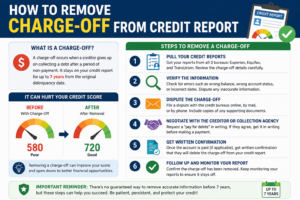
So what exactly happens when a charge-off occurs? It starts when your creditor loses confidence that you’re going to pay them back. At that point, they close your account and write the debt off as a tax loss on their end. This typically kicks in after you’ve gone four to six months without making a payment.
Once that happens, a few things follow pretty quickly — and none of them are good.
First, the moment your account is closed, you lose access to everything tied to it. If it was a rewards credit card, those points or cashback you built up over time? Gone. You don’t get to cash them out or transfer them anywhere.
Then comes the part that trips a lot of people up. Your creditor doesn’t just close the account and move on — they usually sell your unpaid debt to a collections agency. And this is where things get a little more complicated on your credit report.
Once the debt lands with a collector, you’ll likely see it appear on your credit report twice. The first entry is the original account, now showing as closed with a zero balance. The second is the brand new collection account, carrying a balance that reflects what you originally owed — plus whatever additional interest or fees have been added on top. Two entries, one debt, and both dragging down your score.
How a Charge-Off Affects Your Credit
There’s no way around it — charge-offs are bad for your credit. But here’s what most people don’t realize until it’s too late: the real damage actually happens before the charge-off ever hits your report.
Think about it. Before a creditor can officially charge off your debt, you’ve already had to miss at least four months of payments. That’s four separate negative marks hitting your credit report, one after another. If you started with a solid credit score, watching it drop with each missed payment is genuinely painful. I’ve sat across the table from people who lost close to 100 points from a single missed payment alone — not four, just one. So you can imagine what several months of missed payments does, and then add the charge-off on top of that.
The ripple effects don’t stop at your credit score either. Once your credit takes that kind of hit, it starts affecting other areas of your life in ways you might not expect:
- Getting approved for a new loan or credit card becomes a real struggle
- Landlords and even some employers run credit checks — and a charge-off can cost you an apartment or a job opportunity
- Your car insurance rates can climb higher than average, simply because of what’s showing on your report
The saving grace — if you can call it that — is that negative information doesn’t stay on your credit report forever. Missed payments and charge-offs fall off after seven years. And the older that negative mark gets, the less weight it carries on your score. It won’t feel that way in the beginning, but time does work in your favour here.
Can a Charge-Off Actually Be Removed from Your Credit Report?
The short answer is — sometimes. The Fair Credit Reporting Act gives you the right to dispute and remove inaccurate information from your credit reports, and that includes charge-offs. But here’s where people run into a wall: if the charge-off is accurate, paying it off alone usually won’t make it disappear. It’ll just show as “paid” instead of “unpaid,” which is slightly better, but it’s still sitting there on your report.
That said, there are some additional steps you can take to try and get it removed. No guarantees — but I’ve seen these work.
Steps to Remove a Charge-Off from Your Credit Report
1. Validate the Debt First
If a debt collector reaches out about a charge-off you don’t recognize, don’t panic — and don’t pay anything yet. Before you send a single dollar to anyone, make sure the debt actually belongs to you.
Your best move here is to request a debt validation letter. This is a document the collector is required to provide, and it lays out all the details of the debt — who you owe, how much, and where the debt originated. If after reviewing it you’re confident the debt isn’t yours, dispute it in writing within 30 days. That window matters, so don’t sit on it.
2. Negotiate a Pay-for-Delete Agreement
If the debt is legitimate and you want your best shot at actually getting it off your report, this is the approach I’d recommend first — settling the debt with a lump-sum payment paired with a pay-for-delete agreement.
Here’s how it works. You contact the debt collector and offer to pay a lump sum — often less than the full amount owed — in exchange for them removing the account from your credit reports entirely. It sounds simple, but the details matter a lot. Here’s how to do it right:
- After validating the debt, reach out to the collector and start negotiating. Make it clear you’re offering a lump-sum settlement in exchange for complete removal from your credit reports — not just a “paid” status update.
- If you land on a number you can both agree to, get everything in writing before you pay a single cent. That written agreement should include your account number, the collector’s contact information, the exact payment amount, a statement that the payment will be accepted as payment in full, and — most importantly — a clear statement that the account will be removed from your credit reports once payment is received.
- Send your payment via certified mail and request a return receipt. Keep that receipt somewhere safe.
One important thing to understand: the creditor has no legal obligation to hold up their end of this deal. You could pay and still find the account on your report. It’s a risk, and it costs you money upfront. But when it works, it works well.
3. Dispute Errors with the Credit Bureaus
If the charge-off on your report is there by mistake — wrong balance, wrong dates, wrong account entirely — you have every right to dispute it and get it corrected or removed. This process is also worth trying if you made a pay-for-delete agreement and the collector didn’t follow through on their end.
The good news here is that disputing doesn’t cost you anything. Here’s how to do it:
- Pull all three of your credit reports for free at AnnualCreditReport.com.
- Go through each one carefully and identify exactly what’s wrong.
- Gather any documentation that supports your case — a payment receipt, a letter from the collector, anything relevant.
- File your dispute directly with the credit bureau reporting the error. You can do it online, by mail, or by phone:
- Equifax: File online or mail a Dispute Request Form to Equifax Information Services, LLC, P.O. Box 740256, Atlanta, GA 30374.
- Experian: File online or send your dispute letter to P.O. Box 4500, Allen, TX 75013.
- TransUnion: Submit online or follow their instructions to file by mail or phone.
Once your dispute is filed, the credit bureau has up to 45 days to investigate and get back to you.
4. Try a Goodwill Deletion
If you’ve already gone through all the steps above and the charge-off is still there, a goodwill deletion is worth a shot — especially if your situation has improved and you’ve got a reasonable explanation for what happened.
A goodwill deletion is essentially writing or calling your creditor and asking them, as a courtesy, to update or remove the negative information from your report. They’re not required to do this, but it does happen. You’ll improve your odds if you:
- Ask them to remove the missed payments specifically, since those tend to hurt your score even more than the charge-off itself
- Mention if you had a solid history of on-time payments with them before things went sideways
- Explain any hardship that caused you to fall behind — job loss, a medical emergency, a death in the family — and provide documentation if you have it
Just be prepared for a “no.” Some lenders have flat-out policies against goodwill deletions. Bank of America is one example. The Department of Education is another. It doesn’t hurt to ask, but manage your expectations going in.
5. When All Else Fails, Get Professional Help
You’ve tried everything and the charge-off is still sitting on your report. Now what?
If the information is genuinely inaccurate and you’re hitting walls, it may be time to bring in legal help. Filing a complaint with your state’s Attorney General’s Office is one route worth exploring.
If the charge-off is accurate though, the hard truth is that you may just have to wait it out. Negative items fall off your report after seven years, and the damage they do fades over time. What you can do in the meantime is focus on rebuilding — making on-time payments, keeping your balances low, and slowly adding positive history back to your report. A certified credit counselor can help you build a real plan for getting back on solid ground, and that one-on-one guidance can make a bigger difference than most people expect.
Mistakes to Avoid When Dealing with a Charge-Off
Let’s talk about what not to do — because a few common mistakes can make an already bad situation much worse.
The first one I see all the time is people turning to for-profit credit repair companies thinking they’ll fix everything. I get it — when your credit is in rough shape, those ads promising fast results sound appealing. But here’s the reality: companies like Lexington Law and CreditRepair.com have actually been cited by the Consumer Financial Protection Bureau for illegally charging upfront fees and running deceptive advertising. The CFPB’s position is pretty clear — these companies charge a lot, and they can’t guarantee you’ll see any results at all. Save your money.
On the flip side, the other big mistake is doing nothing. Ignoring a charge-off doesn’t make it go away. Unpaid debt keeps accumulating interest, and if you let it go long enough, you could end up facing a lawsuit or even wage garnishment. That’s a much harder hole to dig out of.
The right move is somewhere in the middle. Respond to letters and calls from the debt collector — ignoring them only makes things worse. And if you can, start setting money aside so that when the time comes, you have the option to negotiate a settlement. Having that leverage can help you avoid legal trouble and put you in a better position when you eventually need to qualify for a loan.
How Long Does a Charge-Off Stay on Your Credit Report?
A charge-off sticks around on your credit report for seven years — and that clock starts from the date you first stopped making payments, not from when the charge-off was officially reported.
Here’s a real example to make that clearer. Say you missed some payments in 2024, caught up briefly in early 2025, but then stopped paying again in June 2025. That charge-off would stay on your credit reports until June 2032. Seven years from your last missed payment cycle.
That said, there are a few situations where a charge-off might come off your report earlier than that:
- If the creditor made a reporting error and you successfully dispute it with the credit bureaus
- If a creditor agrees to remove it as part of a settlement or pay-for-delete agreement
- In certain legal situations, like bankruptcy, or if your state has specific consumer protection laws that apply to your case
These aren’t common, but they do happen — which is why it’s always worth checking your report carefully and knowing your options.
How to Rebuild Your Credit After a Charge-Off
Here’s something important to hold onto when things feel hopeless: your credit score is not permanent. No matter how low it drops, it can go back up. It takes time and it takes consistency, but it absolutely can be done.
Here’s what actually moves the needle:
Pay everything on time, every time. This is the single most powerful thing you can do. Payment history is the biggest factor in your credit score, so every on-time payment is a step in the right direction.
Stop carrying credit card balances month to month. High utilization drags your score down even when you’re making payments. If your debt load feels unmanageable, look into a Debt Management Plan — it’s a structured way to pay down what you owe without taking on new debt.
Get added as an authorized user. If you have a family member or close friend with a solid credit history, ask them to add you as an authorized user on one of their credit cards. Their positive account history shows up on your report and can give your score a real boost — even if you never use the card.
Hold off on new credit applications. Every hard inquiry takes a small hit on your score, and applying for loans or cards you can’t comfortably afford only creates more problems down the road. Wait until you’re in a stronger position.
Check your credit reports regularly. You can pull all three reports for free at AnnualCreditReport.com. Go through them carefully and dispute anything that looks wrong. Errors are more common than most people realize, and fixing them costs you nothing.
The Bottom Line on Charge-Offs
If a charge-off ended up on your report by mistake, dispute it. File with the credit bureaus, attach any documentation you have, and follow up. Errors can be removed, and it doesn’t cost you anything to try.
If the charge-off is accurate, the honest truth is it will likely stay on your report for seven years. Your best shot at getting it removed early is a pay-for-delete agreement — but get every detail in writing before you pay anything, because collectors are not legally required to hold up their end of the deal.
And if you’ve tried everything and feel stuck, don’t go it alone. Working with a certified credit counselor can give you a real plan — not just for dealing with the charge-off, but for managing your debt, rebuilding your score, and getting your overall finances back on solid ground. Sometimes that one conversation is what changes everything.
FAQs:
Can we remove paid Charge-0ff
Paid charge-offs or any other negative information cannot be removed from your credit reports on your own. If you pay off a charged-off account, the balance will show as $0, but the account itself will still remain on your credit reports.