What Is a Good Credit Score in 2026?
Your credit score is one of those numbers that quietly shapes your entire financial life. It decides whether you get approved for an apartment, what interest rate you’ll pay on a car loan, and sometimes even whether a potential employer takes you seriously. Yet most people have only a vague idea of what their score actually means — or what qualifies as “good” in today’s lending environment.
In 2026, the credit landscape has continued to evolve. Lenders have tightened standards in some areas, new scoring models have gained wider adoption, and economic pressures have pushed average consumer scores in interesting directions. So let’s settle the question once and for all — what is a good credit score right now, and more importantly, what does yours mean for your real life?
The Credit Score Range: A Quick Refresher
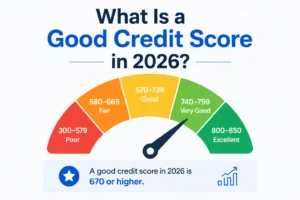
Before we talk about what’s “good,” you need to understand the playing field. The most widely used credit scoring model is the FICO Score, which ranges from 300 to 850. VantageScore — developed jointly by the three major credit bureaus — uses the same 300–850 range as well, making comparisons relatively straightforward.
Here’s how both models generally categorize scores:
| Score Range | Rating |
|---|---|
| 800 – 850 | Exceptional |
| 740 – 799 | Very Good |
| 670 – 739 | Good |
| 580 – 669 | Fair |
| 300 – 579 | Poor |
So technically, a “good” credit score starts at 670. But as you’ll see, good enough to qualify for credit and good enough to get favorable terms are two very different things.
What Lenders Actually Consider “Good” in 2026
Here’s where it gets practical. The label on a score range is one thing — what lenders actually do with your number is another.
In 2026, most mainstream lenders consider a score of 700 or above to be the comfortable starting point for approval on standard loan products. Below that, you might still get approved, but expect higher interest rates, lower credit limits, or requests for a co-signer.
For the best rates — the kind you see advertised on car dealership billboards or mortgage comparison websites — lenders typically want to see 740 or higher. At that level, you’re firmly in the “very good” tier, and most lenders will compete for your business.
If you’re sitting at 760 or above, you’re in elite territory for most loan products. The difference in interest rates between a 700 and a 760 can be surprisingly large. On a 30-year mortgage, for example, a difference of just half a percentage point in interest rate translates to tens of thousands of dollars over the life of the loan. That’s real money — the kind that could fund a year of your kid’s college or let you retire six months earlier.
And at 800 or above? You’re in the top tier of American borrowers. Lenders roll out the red carpet. You’ll qualify for the lowest available rates, the highest credit limits, and the most favorable terms on virtually every financial product.
Why Your Score Might Look Different Depending on Where You Check
One of the most confusing things about credit scores in 2026 is that you don’t have just one. You have dozens.
FICO alone has over 40 different scoring models, each designed for different types of lenders. There’s a FICO Auto Score used by car lenders, a FICO Bankcard Score used by credit card issuers, and a FICO Mortgage Score used by home lenders — among many others. Each model weighs your credit behavior slightly differently depending on what matters most for that specific type of lending.
Then there’s VantageScore, which some lenders prefer and which also has multiple versions. VantageScore 4.0 — the most current widely used version — incorporates trended credit data, meaning it looks at whether your balances are going up or down over time, not just what they are at a single snapshot in time. This can work in your favor if you’ve been consistently paying down debt.
What this means practically: the score you see on your bank’s app, your credit card portal, or a free monitoring site might be different from the score a mortgage lender pulls when you apply for a home loan. Sometimes the difference is small. Sometimes it’s enough to push you from one tier to another.
This isn’t a scam — it’s just the nature of a fragmented scoring ecosystem. The best approach is to monitor your scores regularly across multiple sources and focus less on the exact number and more on the direction it’s moving.
What Actually Goes Into Your Credit Score?
Understanding what drives your score is more useful than obsessing over the number itself. FICO scores are calculated using five factors, each weighted differently:
Payment History (35%) — This is the single biggest factor. Every on-time payment strengthens your score. Every missed payment hurts it, and the more recent the miss, the more damage it does. A payment that’s 90 days late is significantly more damaging than one that’s 30 days late. If you do nothing else for your credit, pay every bill on time, every month, without exception.
Amounts Owed / Credit Utilization (30%) — This measures how much of your available credit you’re actually using. If you have a $10,000 credit limit and you’re carrying a $4,000 balance, your utilization is 40%. Most experts recommend keeping it below 30%, and the people with the highest scores typically keep it below 10%. This is one of the fastest factors to change — pay down balances and your score can improve in a matter of weeks.
Length of Credit History (15%) — The longer your accounts have been open, the better. This is why financial advisors often warn against closing old credit cards even if you don’t use them anymore. That 12-year-old card you never touch? It’s quietly helping your score by aging your average account age.
Credit Mix (10%) — Lenders like to see that you can manage different types of credit responsibly. A mix of revolving credit (credit cards) and installment loans (mortgage, car loan, student loan) signals a well-rounded borrower. You don’t need to take out loans just to diversify — but if you have only credit cards, adding an installment loan (or vice versa) can give your score a modest boost.
New Credit / Hard Inquiries (10%) — Every time you apply for new credit, a hard inquiry is placed on your report. One or two inquiries have minimal impact. Multiple applications in a short period can make lenders nervous, as it suggests you might be in financial distress. The exception: when you’re rate-shopping for a mortgage or auto loan, multiple inquiries within a 14–45 day window are typically counted as a single inquiry by most scoring models.
Average Credit Scores in 2026: Where Does America Stand?
As of 2026, the average American FICO Score sits in the 714–718 range — comfortably in “good” territory. This reflects a trend of gradual improvement over the past decade, fueled by increased access to credit monitoring tools, greater financial literacy resources, and the lingering effect of consumers who paid down debt during periods of economic uncertainty.
However, averages can be deceiving. Scores vary significantly by age group, income level, and geography. Younger consumers — particularly those in their 20s who are just establishing credit — typically have lower scores simply due to shorter credit histories, regardless of how responsibly they manage their accounts. Meanwhile, consumers in their late 50s and 60s tend to have the highest scores, having had decades to build long, positive credit histories.
What a Good Credit Score Gets You in 2026
Let’s make this concrete, because abstract score ranges only mean so much.
Mortgage Loans: To qualify for a conventional mortgage with the best available rates in 2026, you generally need a score of 740 or higher. FHA loans, which are government-backed, allow scores as low as 580 with a 3.5% down payment — but you’ll pay mortgage insurance and higher rates. At 760+, you could save $200–$400 per month compared to a borrower with a 640 score on the same loan amount.
Auto Loans: Car lenders typically reserve their lowest rates — often advertised as 0% or near-zero promotional financing — for buyers with scores of 720 or above. Drop below 660 and you’re in subprime territory, where rates can run two to four times higher than prime rates.
Credit Cards: The best rewards cards — the ones with valuable travel points, cash back, and no foreign transaction fees — generally require scores of 700 or above for approval. Premium cards from top issuers typically want 720–740 minimum. Below 620, you’re largely limited to secured cards or cards with annual fees and low limits.
Personal Loans: Online lenders have expanded access to personal loans for borrowers across the credit spectrum, but rate differences remain stark. A borrower with a 780 score might lock in a personal loan at 7–9% APR. The same borrower with a 620 score might face 20–28% APR for the identical loan amount.
Renting an Apartment: Most landlords in major cities run credit checks and look for scores of at least 620–650 for standard rentals. Luxury buildings often want 700 or higher. A low score can mean a larger security deposit, a co-signer requirement, or an outright rejection.
How to Improve Your Credit Score in 2026
If your score isn’t where you want it, here’s the honest truth: there are no shortcuts, but there are smart, strategic moves that produce real results faster than you might expect.
Fix errors on your report first. Pull your free credit reports from AnnualCreditReport.com and go through every line. Dispute anything inaccurate — wrong balances, accounts that aren’t yours, late payments that were actually on time. This is the one area where your score can improve quickly without changing any financial behavior.
Bring down your credit utilization. If you’re carrying high balances relative to your credit limits, this is the fastest lever you can pull. Pay down balances aggressively, and consider asking your credit card issuers for a credit limit increase (without spending more) to improve your ratio automatically.
Never miss a payment. Set up autopay for at least the minimum due on every account. One 30-day late payment can drop a score by 50–100 points. It’s one of the most disproportionately damaging things that can happen to your credit, and it’s almost entirely preventable.
Be patient with the long game. Some credit score improvements simply take time. A bankruptcy stays on your report for 10 years. A late payment stays for 7. A short credit history grows longer with each passing month. There’s no workaround for this — only consistent, responsible behavior over time.
Consider a secured credit card or credit-builder loan if you’re starting from scratch or rebuilding after a major setback. These tools are specifically designed to help you establish positive payment history with minimal risk.
Our Recommendation Top 5 Credit Repair Companies
- The Credit Pros – Best for Comprehensive Plans
- Credit Saint – Best for Customized Pricing
- Sky Blue Credit – Best Value
- The Credit People – Best for Low Setup Fees
- Credit Firm– Best for Legal Support
The Bottom Line
In 2026, a good credit score is 670 or above by official definitions — but if you want the kind of score that actually opens doors and saves you significant money over your lifetime, aim for 740 and above.
Your credit score is not a measure of your worth as a person. It’s a financial tool, and like any tool, understanding how it works puts you in control. Whether you’re at 580 or 780 right now, the path forward is the same: pay on time, keep balances low, avoid unnecessary new credit, and let time do the rest.
The best credit score you can have is the one you’re actively working to improve.

About Stephen Joseph:
Stephen is a financial journalist with over a decade of experience covering personal finance, investing, and small business. His work has been widely featured across major outlets including MSN Money, Business Insider, Fox Business, and CBS News MoneyWatch. He currently serves as a financial planning expert and journalist.
In addition to his editorial work, Stephen partners with leading brands in the financial services industry — including Citibank, Discover Bank, and AIG Insurance — helping shape content strategy that connects with real consumers. Before transitioning into financial journalism, He built his professional foundation in sales within the communications industry.
Stephen holds a bachelor’s degree in Political Science from the University of South Carolina and a master’s degree from Charleston Southern University.