Credit Repair vs Debt Consolidation vs Credit Counseling: Which Path Is Right for You?
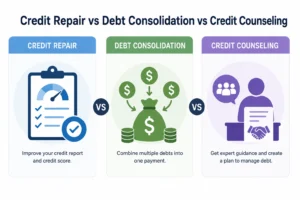
When your finances start feeling like quicksand — the more you struggle, the deeper you sink — it’s easy to grasp at any solution that promises relief. You’ve probably come across terms like credit repair, debt consolidation, and credit counseling. They sound similar, they’re often marketed together, and yet they serve very different purposes.
Understanding the difference between these three options could be the single most important financial decision you make this year. Choose the wrong one, and you might spend hundreds of dollars solving the wrong problem. Choose the right one, and you could be on a clear path toward financial stability within months.
Let’s break each one down — honestly, clearly, and without the sales pitch.
What Is Credit Repair?
Credit repair is the process of identifying and challenging errors, inaccuracies, or outdated negative items on your credit report. The goal is straightforward: clean up what’s on your report so your credit score improves.
Here’s the thing most people don’t realize — your credit report is not always accurate. Studies have shown that a significant portion of consumers have at least one error on their credit reports. These errors range from simple clerical mistakes (wrong address, misspelled name) to more serious issues like accounts that don’t belong to you, incorrect late payment records, or debts that have already been paid but still show as outstanding.
Credit repair works by disputing these inaccuracies with the three major credit bureaus — Equifax, Experian, and TransUnion. Under the Fair Credit Reporting Act (FCRA), bureaus are legally required to investigate your dispute within 30 days and remove anything they cannot verify.
Credit Repair vs Debt Consolidation vs Credit Counseling
You can do this yourself for free. All it takes is writing a dispute letter, gathering supporting documents, and mailing or submitting them online to the bureaus. The process is tedious but entirely manageable.
Alternatively, you can hire a credit repair company to do it for you. These companies charge a monthly fee — typically between $50 and $150 — to review your reports, draft dispute letters, and follow up on your behalf. The Credit Repair Organizations Act (CROA) prohibits them from charging upfront fees before they’ve done any work, so be wary of anyone asking for payment before services are rendered.
What credit repair does NOT do: It cannot legally remove accurate negative information from your report. A legitimate missed payment from two years ago will stay on your report for seven years. Any company promising to erase accurate negative items is either lying or using questionable tactics that could backfire.
Best for: People whose credit scores are being dragged down by errors, outdated information, or identity theft — not by actual poor financial behavior.
What Is Debt Consolidation?
Debt consolidation is a strategy for simplifying and potentially reducing the cost of your existing debt. Instead of juggling five different credit card payments with five different interest rates and five different due dates, you combine them into a single loan or payment.
There are two primary ways people consolidate debt:
Balance Transfer Credit Cards: You move your high-interest credit card balances onto a new card that offers a 0% introductory APR for a promotional period — usually 12 to 21 months. If you can pay off the balance before the promotional period ends, you pay little to no interest. The catch? There’s typically a balance transfer fee of 3–5%, and if you don’t pay it off in time, the remaining balance gets hit with the card’s standard rate, which can be brutally high.
Personal Loans: You take out a fixed-rate personal loan and use it to pay off all your existing debts. Now you have one monthly payment with a fixed interest rate and a clear payoff date. This works especially well when your credit score is good enough to qualify for a loan with a lower rate than your current debts carry.
What makes debt consolidation appealing is the psychological simplicity. One payment. One interest rate. One due date. For people who struggle to keep track of multiple accounts, this alone can prevent missed payments and further credit damage.
However, debt consolidation is not a magic cure. If you consolidate your credit card debt and then run those cards back up, you’ve doubled your problem. The math might work out beautifully on paper, but it requires discipline to actually work in real life.
What debt consolidation does NOT do: It doesn’t reduce the principal amount you owe (unless you negotiate a settlement, which is a different thing entirely). It also doesn’t fix the spending habits or financial gaps that caused the debt in the first place.
Best for: People with manageable debt loads who are paying high interest rates across multiple accounts and want to streamline payments and reduce interest costs.
What Is Credit Counseling?
Credit counseling is perhaps the most holistic of the three options. It involves working with a trained financial counselor — usually from a nonprofit agency — who helps you understand your overall financial picture, build a budget, and develop a plan to pay down your debt over time.
The National Foundation for Credit Counseling (NFCC) and the Financial Counseling Association of America (FCAA) are two well-known organizations that connect consumers with certified, nonprofit credit counselors. These sessions are often free or available at a very low cost.
During a credit counseling session, a counselor will review your income, expenses, debts, and financial goals. They’ll help you create a realistic monthly budget and identify where your money is going versus where it should be going. This alone can be eye-opening for many people.
If your situation calls for it, a credit counselor might recommend you enroll in a Debt Management Plan (DMP). Under a DMP, the credit counseling agency negotiates with your creditors on your behalf to potentially lower your interest rates and waive certain fees. You then make a single monthly payment to the agency, which distributes the funds to your creditors. Most DMPs take three to five years to complete.
It’s important to distinguish credit counseling from credit repair. Credit counseling doesn’t dispute items on your credit report — it focuses on helping you manage and eventually pay off what you legitimately owe. And while your score may temporarily dip when you enroll in a DMP (because accounts are often closed or restricted), consistent on-time payments throughout the program will steadily rebuild your credit.
What credit counseling does NOT do: It can’t make your debt disappear, and it can’t fix errors on your credit report. It also requires a real commitment of time and behavioral change.
Best for: People who feel overwhelmed by debt, don’t know where to start, struggle with budgeting, or owe too much to handle alone but want to avoid bankruptcy.
Side-by-Side Comparison
| Credit Repair | Debt Consolidation | Credit Counseling | |
|---|---|---|---|
| Primary Goal | Fix credit report errors | Simplify and reduce debt costs | Budgeting, financial education, debt payoff |
| Addresses Debt? | No | Yes | Yes (via DMP) |
| Fixes Credit Report? | Yes | Not directly | Not directly |
| Average Cost | $50–$150/month (or free DIY) | Interest rates vary; balance transfer fees | Free to low-cost |
| Timeline | 3–6 months typical | Varies by loan term | 3–5 years for DMP |
| Best For | Credit report errors, fraud | High-interest, multiple debts | Budgeting help, overwhelming debt |
Can You Use More Than One?
Absolutely — and in many cases, you should.
Imagine someone who has three maxed-out credit cards, a collection account on their report that doesn’t actually belong to them, and no clear budget plan. They could legitimately benefit from all three approaches simultaneously:
- Credit repair to challenge the inaccurate collection account
- Debt consolidation to reduce the interest burden on their credit cards
- Credit counseling to establish a budget and develop long-term financial habits
These strategies aren’t mutually exclusive. In fact, combining them thoughtfully can accelerate your path to financial recovery more than any single solution could.
Warning Signs to Watch For
The financial services industry is, unfortunately, riddled with predatory players who prey on people in vulnerable situations. Here’s what to watch out for:
In credit repair: Avoid companies that guarantee specific score increases, promise to remove accurate negative information, or ask for large upfront payments. These are red flags that often signal scams.
In debt consolidation: Be cautious of for-profit debt settlement companies that claim to negotiate your debts for a fee. They often ask you to stop paying creditors (tanking your credit in the process), hold your money in escrow accounts for months, and charge fees of 15–25% of the enrolled debt amount. The damage they cause is often worse than the problem they’re supposed to fix.
In credit counseling: Stick to nonprofit agencies certified by the NFCC or FCAA. Some for-profit companies disguise themselves as credit counseling services while charging excessive fees for services you could access for free elsewhere.
Our Recommendation Top 5 Credit Repair Companies
- The Credit Pros – Best for Comprehensive Plans
- Credit Saint – Best for Customized Pricing
- Sky Blue Credit – Best Value
- The Credit People – Best for Low Setup Fees
- Credit Firm– Best for Legal Support
Which One Should You Choose?
Here’s a simple framework to guide your decision:
Start with your credit report. Pull free copies from AnnualCreditReport.com and review them carefully. If you find errors — wrong accounts, incorrect payment history, unfamiliar collections — credit repair is your first step.
Assess your debt level. If you’re carrying high-interest debt across multiple accounts but your income is stable and the total is manageable, debt consolidation might be your most cost-effective move.
Evaluate your financial habits. If you’re struggling to make ends meet, unsure where your money goes, or feel completely overwhelmed, credit counseling will give you the foundation and support you need before anything else can truly work.
And if you’re facing serious financial hardship — significant job loss, medical debt, or debt that exceeds your realistic ability to repay — it may be worth consulting with a bankruptcy attorney before committing to any long-term debt payoff program. Sometimes, a fresh legal start is the most pragmatic choice.
The Bottom Line
Credit repair, debt consolidation, and credit counseling each serve a specific purpose. None of them is universally “the best” — the right choice depends entirely on your individual financial situation.
What they all have in common, though, is this: they work best when paired with honest self-reflection and a genuine commitment to changing the financial behaviors that led you here. Tools and programs can help, but lasting financial health comes from building habits that last longer than any promotional period or payment plan.
Take your time, do your research, and don’t let urgency drive you into the arms of someone more interested in your wallet than your wellbeing. The right path forward exists — you just have to choose it carefully.

About Stephen Joseph:
Stephen is a financial journalist with over a decade of experience covering personal finance, investing, and small business. His work has been widely featured across major outlets including MSN Money, Business Insider, Fox Business, and CBS News MoneyWatch. He currently serves as a financial planning expert and journalist.
In addition to his editorial work, Stephen partners with leading brands in the financial services industry — including Citibank, Discover Bank, and AIG Insurance — helping shape content strategy that connects with real consumers. Before transitioning into financial journalism, He built his professional foundation in sales within the communications industry.
Stephen holds a bachelor’s degree in Political Science from the University of South Carolina and a master’s degree from Charleston Southern University.