Credit Karma vs. Experian: A Detailed Comparison of Credit Services
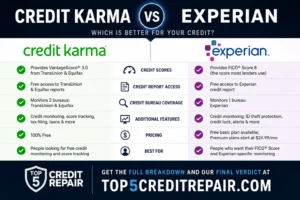
If you’re looking to check your credit score or review your credit report, Credit Karma and Experian are both solid choices worth considering.Though they serve a similar purpose, the two work quite differently under the hood. Credit Karma is a free online platform that pulls your VantageScore 3.0 from both TransUnion and Equifax, making it a convenient one-stop shop. Experian, on the other hand, is one of the big three credit bureaus itself and gives you access to your FICO score, which is the score most lenders actually use.
Credit Karma vs Experian
What makes Credit Karma stand out is how easy and approachable it is — the interface is clean, and it comes loaded with helpful financial articles, personalized tips, and easy-to-read reports. Experian brings its own strengths to the table, backed by global credibility and a wide range of credit products and monitoring tools.
Key Takeaways
- Credit Karma gives you free access to your VantageScore 3.0, pulling data from both TransUnion and Equifax — at no cost.
- Experian works differently, offering the widely-used FICO Score 8 along with both free and paid options for viewing your credit report.
- One thing worth knowing — Credit Karma doesn’t include FICO scores or pull anything from Experian, so there’s a gap there if that’s what you need.
- Experian also has a handy tool called Experian Boost, which can actually help lift your score by factoring in on-time payments for things like utilities and subscriptions.
- If you just want a straightforward look at your credit history, you can grab a free annual report from all three major bureaus through AnnualCreditReport.com.
Can I Trust Credit Karma?
Let’s say you’re gearing up to apply for a big loan and want to keep a close eye on your credit score in the meantime — Credit Karma seems like an obvious starting point. But before you dive in, it’s worth asking: how reliable are the scores it actually shows you? And are there any catches you should know about upfront?
Credit Karma is a perfectly legitimate service, no doubt about that. However, the scores it provides can sometimes look quite different from what your lender sees when they pull your credit. There are a few reasons behind this gap, and being aware of them ahead of time can save you from any unexpected surprises down the road.
Credit Karma: Features and Benefits
Credit Karma is not a credit bureau — it’s an online financial platform that brings credit bureau information directly to consumers in one easy place. Members can check and monitor their credit scores and reports completely free of charge. On top of that, the platform offers a range of financial tools and educational resources designed to help you understand and improve your credit over time.
The company was founded back in 2007 by CEO Kenneth Lin and operated as a private company until early 2020, when Intuit announced it would be acquiring Credit Karma for a whopping $7.1 billion.
Since Credit Karma is entirely online, everything is handled through their website. Once you register as a member, you can view your credit scores and reports, and even print them or save them as PDFs if needed. You also have the option to link your bank and credit card accounts to get a broader picture of your overall financial health. The platform is accessible both through a web browser and a mobile app available for iPhone and Android devices.
When it comes to scores, Credit Karma provides VantageScore 3.0 ratings sourced from both TransUnion and Equifax. The VantageScore model itself was developed as a joint effort between all three major credit bureaus, including Experian. Your scores are refreshed once a week, and members also have the option to sign up for credit monitoring alerts, so you’ll get a heads-up whenever something changes on your report.
How Experian Works and What It Offers
Experian is one of the three major credit reporting bureaus in the United States, sitting alongside TransUnion and Equifax. It provides consumers with access to their FICO Score 8, which is one of the most widely used credit scoring models by lenders today. As a global company, Experian is headquartered in Dublin, Ireland, and is publicly listed on the London Stock Exchange.
The company is quite large in scale, employing around 27,000 people and operating across 30 countries worldwide. Its business is built around four main areas — credit services, marketing services, decision analytics, and consumer services — making it much more than just a credit reporting agency.
For everyday consumers, Experian offers free credit reports as well as options to access your credit score at no cost directly through their website. So whether you’re simply keeping tabs on your credit health or preparing for a major financial decision, Experian gives you a few straightforward ways to stay informed without spending a dime.
How Credit Karma and Experian Compare
Credit Karma
Credit Karma keeps things simple by offering everything at no cost — credit scores, full credit reports, ongoing monitoring, and real-time alerts. And unlike most platforms that lure you in with a “free trial” and then ask for your credit card details, Credit Karma never requires that.
The platform also does a solid job of recommending credit cards that actually make sense for your financial situation — ones you’re likely to get approved for and that could save you money. Beyond that, the site is built around helping you understand and grow your credit over time. You’ll find handy financial calculators, breakdowns of the key factors that influence your score, a personalized grade for each one, and tips on how certain financial decisions might impact your overall rating. As a bonus, Credit Karma even lets you file your federal taxes and select state returns for free.
Experian
Experian takes a different approach, offering a mix of free tools alongside paid packages. One of their popular paid options is the 3-Bureau Credit Report and FICO Score, available for $39.99. This gives you scores from all three major bureaus — Experian, Equifax, and TransUnion — along with a breakdown of what’s helping or hurting your scores.
One thing worth noting is that Experian’s report pull is a one-time snapshot. The information won’t refresh after your first access, but you can still refer back to those initial reports for up to 180 days.
For ongoing access, Experian offers two tiers through its CreditWorks program. The Basic plan is completely free and includes:
- Free Experian Credit Report and FICO Score
- Experian Boost to help raise your FICO Score
- Report and Score updated every 30 days
- FICO Score Monitoring using Experian data
- Credit Monitoring and Alerts
- Free Dark Web Surveillance Report
- Personalized Credit Card and Loan Matches
If you want more, you can upgrade to CreditWorks Premium for $24.99 a month after a free seven-day trial. The premium tier adds:
- Monthly 3-Bureau FICO Scores
- 3-Bureau Credit Monitoring and Alerts
- Daily FICO Scores based on Experian data
- Experian CreditLock with Alerts
- FICO Score Tracker
- Identity Protection and Alerts
- Up to $1 Million in Identity Theft Insurance
- Dedicated Fraud Resolution Support
- Lost Wallet Assistance
For those who want even broader protection, Experian’s IdentityWorks plans combine credit monitoring with identity theft coverage. The Family plan runs $34.99 per month and the Premium plan is $24.99 per month, both following a free seven-day trial.
Finally, Experian offers a feature called Experian Boost, which is worth mentioning on its own. It allows you to add positive payment history from utility and telecom bills directly to your Experian credit report, giving your score an instant lift without any extra effort.
FAQs Section:
What Is Credit Karma Actually Used for?
At its core, Credit Karma is a free tool that gives you easy access to your credit score whenever you need it. Most people use it as a convenient way to keep an eye on their credit health over time — checking in regularly to see where they stand and spotting any changes before they become bigger issues.
What Counts as a Good Experian Credit Score?
Generally speaking, hitting 700 or above puts you in “good” territory. But if your score reaches 740, that bumps you up to “very good,” which can make a real difference when it comes to the interest rates lenders offer you. And if you’ve managed to push your score past 800, that’s considered “exceptional” — the kind of number that opens doors to the best financial products available.
Is Experian the Most Accurate Credit Score?
The truth is, all three major bureaus — Experian, Equifax, and TransUnion — are considered equally accurate. The real factor behind score accuracy isn’t which bureau you use, but rather how accurate the information is that lenders and creditors report to them in the first place. If something looks off on your report, it’s always a good idea to pull your full credit report and double-check that everything on file is correct.

About Stephen Joseph:
Stephen is a financial journalist with over a decade of experience covering personal finance, investing, and small business. His work has been widely featured across major outlets including MSN Money, Business Insider, Fox Business, and CBS News MoneyWatch. He currently serves as a financial planning expert and journalist.
In addition to his editorial work, Stephen partners with leading brands in the financial services industry — including Citibank, Discover Bank, and AIG Insurance — helping shape content strategy that connects with real consumers. Before transitioning into financial journalism, He built his professional foundation in sales within the communications industry.
Stephen holds a bachelor’s degree in Political Science from the University of South Carolina and a master’s degree from Charleston Southern University.