Is Medical Debt Still Hurting Your Credit in Florida? 2026 State-by-State Guide
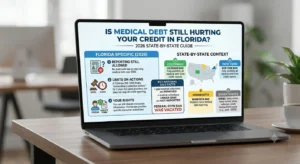
If you’ve ever stared at a hospital bill and then watched your credit score dip a few weeks later, you’re not imagining things — and if you live in Florida, you’re not alone either. Medical debt remains one of the most common, most confusing, and most misunderstood items on American credit reports, and 2026 has brought a fresh round of changes that make the picture even murkier.
Here’s the short version: yes, medical debt can still hurt your credit in Florida. A federal rule that would have wiped most medical debt off credit reports nationwide was struck down in court, and Florida is not one of the handful of states that passed its own ban. But there’s more nuance to the story — some real protections do exist, and knowing exactly how they work can save you from unnecessary credit damage.
Medical Debt Still Hurting Your Credit
This guide breaks down what changed, what didn’t, how Florida compares to other states, and exactly what to do if a medical bill is dragging your score down.
The Quick Answer for Florida Residents
Florida does not have a law that bans medical debt from appearing on credit reports. That puts Florida in a different category than states like California, New York, Colorado, and Illinois, which have passed outright bans on the practice. Florida residents rely mostly on federal protections and voluntary industry rules — plus a few state-specific safeguards around how and when a bill can be sent to collections in the first place.
That means if you have unpaid medical debt over $500 that’s more than a year old, it can legally still show up on your Equifax, Experian, or TransUnion report and drag your score down, sometimes by 20 points or more.
What Happened to the Federal Medical Debt Rule?
Back in January 2025, the Consumer Financial Protection Bureau (CFPB) finalized a sweeping rule designed to strip nearly all medical debt off consumer credit reports and stop lenders from factoring it into credit decisions. The agency estimated it would help around 15 million Americans see a combined $49 billion in medical debt vanish from their files.
It never took effect. Credit reporting trade groups sued, arguing the CFPB had overstepped its legal authority, and in July 2025 a federal judge in the Eastern District of Texas agreed, vacating the rule entirely. The court found the rule conflicted with the Fair Credit Reporting Act, which permits properly coded medical debt to be reported. Then, in October 2025, the CFPB went a step further, issuing an interpretive rule arguing that federal law actually preempts state-level medical debt bans too — a position that has since been contested and remains legally unsettled heading into the rest of 2026.
For Florida residents, the practical effect is simple: the sweeping federal fix never arrived, and the legal fight over whether states can even protect their own residents is still playing out in the background.
What Protections Still Exist Right Now
Even without the CFPB rule, some real protections survived because they came from a separate source: the credit bureaus themselves.
Back in 2022 and 2023, Equifax, Experian, and TransUnion voluntarily agreed to three changes, and these were never touched by the court ruling:
- Paid medical collections are removed from your credit report entirely, regardless of the amount.
- Unpaid medical debt under $500 doesn’t appear on your report at all.
- New medical debt gets a one-year grace period before it can be reported, giving you time to sort out insurance disputes or billing errors.
These voluntary changes reportedly wiped out a large share of medical collection accounts nationwide when they first took effect. They remain fully in place today. What they don’t cover is the debt that matters most: unpaid medical bills over $500 that are older than 12 months. Those can still be reported, still hurt your score, and still sit on your file for years.
Florida’s Own Rules: More Than Nothing, Less Than a Ban
Florida hasn’t banned medical debt reporting, but state lawmakers have added a few guardrails that are worth knowing about:
A shorter window to sue. Florida generally requires medical debt lawsuits to be filed within five years of the debt becoming due, and some medical collection actions face a tighter three-year limit before a lawsuit can even be initiated. Once that window closes, a creditor can’t win a court judgment against you, though the debt can still exist and still appear on your credit file.
Restrictions on “extraordinary collection actions.” Florida law requires hospitals and ambulatory surgical centers to jump through several hoops — providing notice of financial assistance options, sending an itemized bill, giving you time to apply for aid — before they can report a debt to collections, sell it, place a lien, or sue. A 2025 update (SB 656) broadened these requirements to cover more types of hospital bills, not just those tied to a facility’s financial assistance policy.
Limits on debt sales. Florida also placed restrictions on how medical debt can be sold to third-party collectors, which is meant to reduce the number of “zombie debt” situations where an old bill gets resold and resurfaces on your report years later.
Generous exemption laws. This one isn’t about credit reporting, but it matters if a medical creditor sues and wins. Florida’s homestead exemption protects your primary home with no dollar cap, and retirement accounts, annuities, and head-of-household wages are also largely shielded from medical judgment creditors.
None of this stops a legitimate, unpaid medical bill over $500 from eventually landing on your credit report. It just adds friction and paperwork requirements before a provider can pull that trigger.
How Florida Compares: A State-by-State Snapshot
Medical debt credit reporting rules now vary dramatically depending on where you live. Here’s roughly where things stand in 2026:
States with full bans on medical debt credit reporting (roughly 14–16 states, depending on how you count pending effective dates): California, Colorado, Connecticut, Illinois, Maine, Maryland, Minnesota, New Jersey, New York, North Carolina, Oregon, Rhode Island, Vermont, Virginia, and Washington. If you live in one of these states, medical debt generally cannot appear on your credit report at all, regardless of amount or age.
States with partial restrictions, like Florida: Delaware, Idaho, Nevada, and Utah join Florida in this middle tier — states that regulate how or when medical debt can be reported or collected, without banning the practice outright.
Everyone else: Residents in the remaining states rely entirely on the federal baseline — the FCRA plus the voluntary bureau changes described above, with no additional state-level cushion.
It’s worth noting that this patchwork itself is under legal threat. The CFPB’s October 2025 interpretive position, arguing federal law preempts even the strongest state bans, has put every one of those state laws on shakier footing. Advocacy groups and several state attorneys general have pushed back, and the outcome will likely take further litigation to resolve. If you live in a state with a full ban, it’s still your strongest protection today — but it’s not guaranteed to be bulletproof forever.
Why This Keeps Happening: The Bigger Picture
Roughly 100 million Americans carry some form of medical debt, and Florida has its share — estimates suggest well over a million Floridians report owing medical bills in a given year. Unlike a missed credit card payment, medical debt is rarely a sign of poor financial judgment. It’s frequently the product of a surprise diagnosis, an out-of-network specialist you never chose, or simply confusion between what insurance covers and what a provider bills.
Studies commissioned around the original CFPB rule found that removing medical debt from a credit file could lift a score by an average of 20 points or more, which is often the difference between qualifying for a mortgage and getting turned away. That’s precisely why the fight over this rule has continued even after the courts stepped in — the stakes for ordinary people are significant, and healthcare cost pressures are only expected to grow in 2026 as insurance subsidies shift and premiums rise.
What To Do If Medical Debt Is Hurting Your Florida Credit Score
If you suspect a medical bill is dragging your score down, don’t wait for the law to catch up. A few concrete steps can make a real difference:
- Pull all three credit reports. Get your free reports from Equifax, Experian, and TransUnion through AnnualCreditReport.com or Identity Iq and look specifically for medical collection accounts.
- Check the amount and age. If it’s under $500, or if it’s already paid, it should not be on your report under the voluntary bureau rules — that’s an automatic dispute.
- Verify it’s actually yours. Medical billing errors are common — wrong patient, duplicate charges, insurance that should have covered it. Request an itemized bill and compare it against your insurance’s explanation of benefits.
- Dispute directly with the bureau. If you find an error, file a dispute with documentation. Bureaus generally have 30 days to investigate.
- Ask the provider about financial assistance before it reaches collections. Under Florida law, hospitals must offer notice of financial assistance options before pursuing aggressive collection steps — use that window.
- Know your lawsuit deadlines. If you’re contacted about very old medical debt, Florida’s statute of limitations may already have run, which is a valid legal defense if you’re sued (though it won’t remove the item from your credit report on its own).
- Negotiate a pay-for-delete when possible. Some providers or collectors will agree to stop reporting a debt once it’s paid or settled, even outside the standard bureau rules — it never hurts to ask in writing.
Frequently Asked Questions
Is medical debt still hurting credit scores in Florida in 2026?
Yes. Unpaid medical debt over $500 that is more than a year old can still appear on your credit report and affect your score, because Florida has not passed a law banning medical debt reporting the way about 15 other states have.
Did the CFPB’s medical debt rule ever take effect?
No. The rule was finalized in January 2025 but was vacated by a federal court in July 2025 before its effective date, after industry groups argued it exceeded the CFPB’s legal authority.
Can debt collectors still sue me for medical debt in Florida?
Generally yes, within Florida’s statute of limitations, which is typically five years from the date of the debt or the last payment for written contracts, with some medical collection actions subject to a three-year limit. Once that period passes, the debt becomes “time-barred,” meaning a collector generally cannot successfully sue, though it may still appear on your credit report.
Do the credit bureaus still remove small medical debts?
Yes. Equifax, Experian, and TransUnion voluntarily agreed in 2022–2023 to remove paid medical collections regardless of amount, exclude unpaid medical debt under $500, and delay reporting new medical debt for at least a year. These changes were unaffected by the court ruling and remain in place in 2026.
Which states currently ban medical debt from credit reports?
As of 2026, states with full bans include California, Colorado, Connecticut, Illinois, Maine, Maryland, Minnesota, New Jersey, New York, North Carolina, Oregon, Rhode Island, Vermont, Virginia, and Washington, though the legal durability of these laws is being challenged following a CFPB interpretive rule issued in October 2025.
Will removing a medical collection actually raise my score?
Often, yes. Research tied to the original CFPB rulemaking found that removing medical collections from a credit file raised scores by an average of 20 points or more for affected consumers, which can be enough to change loan approval outcomes.
What should I do first if I see medical debt on my Florida credit report?
Start by pulling your reports from all three bureaus and checking whether the debt meets the criteria for automatic removal — paid in full, or under $500. If it doesn’t qualify, verify the debt is accurate before assuming you have to accept it as-is; billing errors are common enough that a documented dispute is always worth filing.

About Stephen Joseph:
Stephen is a financial journalist with over a decade of experience covering personal finance, investing, and small business. His work has been widely featured across major outlets including MSN Money, Business Insider, Fox Business, and CBS News MoneyWatch. He currently serves as a financial planning expert and journalist.
In addition to his editorial work, Stephen partners with leading brands in the financial services industry — including Citibank, Discover Bank, and AIG Insurance — helping shape content strategy that connects with real consumers. Before transitioning into financial journalism, He built his professional foundation in sales within the communications industry.
Stephen holds a bachelor’s degree in Political Science from the University of South Carolina and a master’s degree from Charleston Southern University.