Identity Theft Credit Report Errors: 8 Warning Signs to Catch Now (2026)
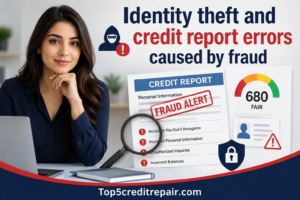
Most people find out about identity theft the same way: not through a warning email, not through a bank alert, but through a credit report that suddenly makes no sense. An account they never opened. A hard inquiry from a lender they’ve never heard of. A balance on a card that’s supposedly been in their wallet the whole time.
That’s the uncomfortable truth about identity theft credit report errors — they rarely announce themselves. They just sit there, quietly dragging down a score, until someone gets denied for a loan or notices a stranger’s collections account buried on page three of their file.
This guide walks through how these errors actually show up, why they’re different from a normal reporting mistake, and exactly what to do once you spot one.
Why This Deserves Its Own Category
Not every credit report mistake is fraud. Sometimes a creditor reports a wrong balance. Sometimes two accounts get merged by accident. Those are ordinary reporting errors, and they’re fixed through a standard dispute.
Identity theft credit report errors are a different animal entirely. They involve accounts, inquiries, or personal information that a criminal — not a clerical mistake — put on your file. That distinction matters because the legal protections, the dispute process, and the urgency are all different. A regular error is inconvenient. A fraud-driven error means someone is actively using your identity, possibly right now, for something you haven’t discovered yet.
The 8 Warning Signs Most People Miss
1. Accounts you don’t recognize. This is the most obvious sign, but people talk themselves out of it constantly — assuming it’s an old account they forgot about, or a joint account from years ago. If you genuinely don’t recognize it after checking, don’t assume; verify.
2. Hard inquiries from lenders you never contacted. A hard inquiry means someone applied for credit in your name. If you didn’t apply, someone else did.
3. A sudden score drop with no obvious cause. If your score dips sharply and you haven’t missed a payment or opened new credit, identity theft credit report errors are one of the first things worth ruling out.
4. Mail or notifications about accounts you never opened. A welcome email for a credit card, a statement for a store card — these often arrive before the account even shows up on your report.
5. A collections account for a debt that isn’t yours. This is especially common with medical identity theft, where a criminal uses stolen insurance information, and the resulting unpaid bill eventually lands in your file as a collection.
6. Your address or employer information changed without your input. Fraudsters sometimes update contact details on an account so that statements and alerts go to them instead of you.
7. A freeze or fraud alert you didn’t set. If one bureau shows a freeze you don’t remember placing, it’s possible someone else placed it — either to block you from noticing new fraudulent activity, or as part of an account takeover.
8. Being denied credit for reasons that don’t match your history. If a lender cites a debt-to-income ratio or delinquency you know isn’t accurate, that denial letter is actually a useful diagnostic tool — it often lists the specific account that triggered it.
Why Fraud-Related Errors Are Harder to Catch Than Normal Mistakes
Ordinary errors tend to be obvious: a balance that’s clearly too high, a payment marked late when you have a bank statement proving otherwise. Identity theft credit report errors are built to blend in. A criminal opening a card in your name uses your real Social Security number, your real birthdate, sometimes even your real former addresses pulled from data breaches. To the credit bureau’s system, the account looks legitimate, because on paper, it is you — just not the you doing the applying.
This is exactly why review sites like NerdWallet treat identity theft as its own specialty category separate from general credit repair. The dispute language, the documentation required, and the legal backing (primarily the Fair Credit Reporting Act and the Fair and Accurate Credit Transactions Act) are different from a routine “this balance is wrong” dispute. Treating a fraud case like an ordinary error slows everything down and can even work against you if the bureau processes it as a simple factual dispute instead of a fraud claim.
What To Do the Moment You Spot One
Step 1: Pull all three reports, not just one. Identity theft credit report errors don’t always show up identically across Equifax, Experian, and TransUnion. A fraudulent account might be reported to only one or two bureaus initially.
Step 2: File an FTC identity theft report at IdentityTheft.gov. This generates an official Identity Theft Report, which is the document that unlocks the strongest legal protections — including the right to block fraudulent information from your file rather than just disputing it.
Step 3: Place a fraud alert or credit freeze. A fraud alert is free and makes lenders verify your identity before extending new credit. A credit freeze goes further, blocking new inquiries entirely until you lift it. Freezing all three bureaus is the more airtight option if you suspect active fraud.
Step 4: Dispute the fraudulent items specifically as identity theft, not as general errors. When submitting a dispute, cite the FTC Identity Theft Report and clearly state the account resulted from fraud. This triggers different handling than “I believe this information is inaccurate.”
Step 5: Contact the creditor directly. Most banks and card issuers have dedicated fraud departments and will close the account and remove it from reporting once fraud is confirmed, often faster than waiting on the bureau dispute alone.
Step 6: Follow up in writing and keep records. Every call, every letter, every confirmation number. Fraud cases sometimes require multiple rounds of documentation before an item is permanently blocked.
Comparison: Fraud Dispute vs. Standard Error Dispute
| Factor | Standard Error Dispute | Identity Theft Dispute |
|---|---|---|
| Trigger | Clerical or reporting mistake | Fraudulent account or inquiry |
| Required Documents | Personal statement, supporting records | FTC Identity Theft Report, police report (optional) |
| Legal Basis | FCRA general dispute rights | FCRA + FACTA fraud provisions |
| Bureau Response | Investigate and correct/remove if inaccurate | Can be blocked outright, not just “investigated” |
| Typical Timeline | 30 days | 30 days, but blocking can be faster once report is filed |
| Recurrence Risk | Low | Higher — same fraud ring may reopen accounts |
Why Blocking Beats Disputing, When Fraud Is Confirmed
A standard dispute asks the bureau to investigate whether information is accurate. A fraud block, backed by an FTC Identity Theft Report, asks the bureau to remove the information because it resulted from a crime — a meaningfully stronger position. Under FACTA, bureaus are required to block fraudulent information within four business days of receiving proof of the identity theft report, rather than running it through the standard month-long investigation.
This is the core reason identity theft credit report errors need to be handled through the fraud-specific process rather than a generic dispute form. Filing generically can still work, but it takes longer and gives the original creditor more room to simply “verify” the account as accurate, since from their system’s perspective, someone did open it using your real information.
Preventing the Next One
Fixing an existing fraudulent account doesn’t guarantee the same criminal, or a different one using leaked data from a breach, won’t try again. A few habits meaningfully lower the odds:
- Freeze your credit by default, and only lift it temporarily when you’re actually applying for something.
- Monitor all three bureaus, not just one — many free monitoring tools only track a single bureau, which leaves gaps.
- Use unique passwords and two-factor authentication on financial accounts, since account takeovers often start outside the credit system entirely.
- Shred or securely store documents with your Social Security number, and be cautious about who legitimately needs it.
- Check your report at least quarterly, even without a specific reason to suspect fraud — catching identity theft credit report errors early is dramatically easier than untangling them a year later.
Medical and Synthetic Identity Theft: The Two Sneakiest Variants
Most people picture identity theft as someone opening a credit card with their name. Two other variants are worth knowing about because they’re harder to spot and slower to unravel.
Medical identity theft happens when someone uses your stolen insurance details to receive treatment, and the unpaid portion eventually gets sent to collections under your name. Victims often have no idea until a collections notice arrives for a hospital visit they never had. Because it touches both your credit file and your medical records, resolving it usually means contacting the healthcare provider’s billing department in addition to the credit bureaus — a step people frequently skip, which lets the error linger.
Synthetic identity theft is more elaborate. A criminal combines a real Social Security number (often a child’s, since it has no credit history to conflict with) with a fabricated name and birthdate, then builds credit slowly over months or years before maxing out the accounts and disappearing. Because there’s no matching real identity to flag as “wrong,” these cases are notoriously difficult to detect through normal monitoring and often surface only when a parent checks a teenager’s credit file for the first time and finds years of unexplained activity.
Both variants can technically avoid tripping the more obvious warning signs, since nothing about them resembles your own spending pattern going haywire. That’s exactly why periodic full-report checks matter even when nothing feels wrong.
What Credit Bureaus Are Actually Required to Do
Once a fraud claim is properly documented, bureaus aren’t just being helpful when they act — they’re following specific legal obligations. Beyond the four-business-day blocking requirement mentioned earlier, bureaus must also notify the furnisher (the bank or creditor that originally reported the fraudulent account) that the information may result from identity theft, and they’re barred from reporting it again unless the furnisher can certify the information is accurate with supporting evidence.
This is a meaningfully higher bar than a standard dispute, where a furnisher can often “verify” an account simply by confirming their own records match what they already reported — which, in a fraud case, just confirms the criminal’s paperwork matched their system, not that the account is legitimately yours.
Why Some Fraud Cases Take Longer Than Others
Not every fraud dispute resolves in four business days, even with a solid FTC report in hand. Cases involving synthetic identities tend to drag longer because there’s genuinely no “original” clean file to revert to — the bureau has to untangle which parts of a blended file belong to the real person and which were fabricated. Cases involving multiple fraudulent accounts opened across different lenders also take longer simply because each creditor runs its own internal fraud review before confirming to the bureau that the account should be removed.
Patience here isn’t about accepting delay passively — it’s about knowing which lever to pull next if a case stalls. If thirty days pass without resolution on a properly filed fraud dispute, escalating with a written complaint to the Consumer Financial Protection Bureau (CFPB) often moves things faster than repeatedly calling the same bureau hotline, since CFPB complaints typically require a formal, tracked response from the company involved.
Final Thoughts
Identity theft credit report errors don’t behave like normal mistakes, and treating them the same way costs time you don’t need to lose. An account you don’t recognize, an inquiry you never made, a score drop with no explanation — these are worth investigating immediately, not explaining away. The moment fraud is confirmed, an FTC Identity Theft Report and a fraud-specific dispute will move faster and hit harder than a standard correction request ever could. The system is built to protect you here — it just requires you to use the right door.
Frequently Asked Questions
How is an identity theft error different from a normal credit report mistake?
A normal mistake is a clerical or reporting error on a legitimate account. An identity theft error involves an account, inquiry, or detail created by someone using your personal information without permission.
Do I need to file a police report to dispute fraud on my credit report?
Not always. An FTC Identity Theft Report from IdentityTheft.gov is usually sufficient, though some creditors may request a police report for larger fraud cases.
Will a credit freeze stop identity theft credit report errors from happening again?
A freeze significantly reduces the risk by blocking new account openings, but it doesn’t undo existing fraud or prevent misuse of accounts you already have open.
How long does it take to remove a fraudulent account from my report?
Once a bureau receives your FTC Identity Theft Report, it’s generally required to block the fraudulent information within four business days, though full resolution with the creditor can take longer.
Can identity theft lower my credit score even if I catch it quickly?
Yes, temporarily. Fraudulent accounts and inquiries can dent your score even briefly, but scores typically recover once the items are blocked or removed and the dispute is resolved.
Should I close all my accounts if I suspect identity theft?
Not necessarily. Focus on the specific compromised accounts first — closing everything can actually hurt your credit history length and utilization ratio without addressing the actual fraud.

About Stephen Joseph:
Stephen is a financial journalist with over a decade of experience covering personal finance, investing, and small business. His work has been widely featured across major outlets including MSN Money, Business Insider, Fox Business, and CBS News MoneyWatch. He currently serves as a financial planning expert and journalist.
In addition to his editorial work, Stephen partners with leading brands in the financial services industry — including Citibank, Discover Bank, and AIG Insurance — helping shape content strategy that connects with real consumers. Before transitioning into financial journalism, He built his professional foundation in sales within the communications industry.
Stephen holds a bachelor’s degree in Political Science from the University of South Carolina and a master’s degree from Charleston Southern University.