How to Build Credit as a Student With No Income
The Complete and Step-by-Step Guide That Covers Everything You Need to Know.
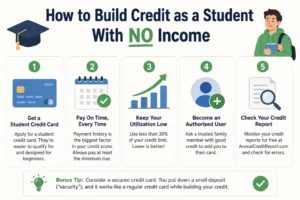
Building credit as a student with no income sounds like a classic catch-22 — you need credit to get credit, and you need income to get approved. But here’s the truth: thousands of students successfully build solid credit every single year without a full-time job or steady paycheck. You just need to know the right doors to knock on and in the right order.
This guide covers everything — from what credit actually is, to exactly which steps to take, to what mistakes to avoid. By the time you finish reading, you will have a complete roadmap to go from zero credit to a respectable score, even as a broke student
First, Let’s Understand What Credit Actually Is
Before doing anything, you need to understand what you are building and why it matters.
Credit is essentially your financial reputation. It is a record of how responsibly you borrow and repay money. Lenders, landlords, employers, and even phone companies check this record to decide whether to trust you with money, an apartment, a job, or a contract.
Your credit reputation is summarized in a credit score — a three-digit number that typically ranges from 300 to 850. The higher the number, the better.
Here is what those numbers mean in real life:
| Credit Score Range | Rating | What It Means For You |
| 800 – 850 | Exceptional | Best interest rates, easiest approvals |
| 740 – 799 | Very Good | Very competitive rates and terms |
| 670 – 739 | Good | Approved for most products |
| 580 – 669 | Fair | Limited options, higher rates |
| 300 – 579 | Poor | Very difficult to get approved |
As a student starting from scratch, you have no score at all — which is called being “credit invisible.” Your goal is to enter the system and climb steadily.
Why Your Credit Score is Calculated the Way It Is
Your score is not random. It is calculated based on five specific factors. Understanding these factors tells you exactly what behaviors to focus on.
- Payment History — 35% of your score This is the single biggest factor. Do you pay your bills on time? Even one missed payment can significantly damage your score. This means on-time payments are your number one priority, always.
- Credit Utilization — 30% of your score This is how much of your available credit you are actually using. If your credit card limit is $500 and you have spent $400, your utilization is 80% — which is far too high. Keeping utilization below 30% (ideally below 10%) is the goal.
- Length of Credit History — 15% of your score The longer your accounts have been open and active, the better. This is why starting early as a student is a smart move — every month you have an account open adds to your history.
- Credit Mix — 10% of your score Having different types of credit (credit cards, installment loans, student loans) shows lenders you can manage various financial products responsibly.
- New Credit Inquiries — 10% of your score Every time you apply for credit, a “hard inquiry” is recorded on your report. Too many inquiries in a short time signals desperation and lowers your score temporarily.
The “No Income” Problem — And How to Get Around It
Most traditional credit cards require proof of income during the application process. As a student with no job or a very part-time income, this feels like a wall. But there are several legal, proven ways around it.
What counts as income on a student application: Many people do not realize that income on a credit application is broader than just a salary. You can typically include:
- Part-time job earnings (even $200/month matters)
- Allowance or regular financial support from parents or family
- Scholarships or grants that cover living expenses
- Financial aid refunds you receive directly
- Freelance or gig work income (tutoring, babysitting, online work)
You do not need to earn a lot. You just need to show some regular source of money coming in.
Step-by-Step: Exactly How to Build Credit as a Student
Step 1 — Become an Authorized User on a Parent’s Credit Card
This is the fastest, easiest, and most powerful starting point for most students.
Here is how it works: A parent, guardian, or trusted family member adds you to their existing credit card account as an authorized user. You get a card in your name linked to their account. Their entire payment history on that card — sometimes going back years — can appear on your credit report immediately.
If your parent has had a credit card for 10 years with a perfect payment history, you could go from zero credit to a solid starting score almost overnight.
What you need to know:
- You do not need to use the card at all for the history to transfer
- Their good behavior helps you, but their missed payments can also hurt you
- Only do this with someone who has excellent credit habits
- There is no income requirement for becoming an authorized user
This single step can give you a meaningful starting score and a foundation to build on.
Step 2 — Open a Student Credit Card
Major credit card companies — including Discover, Capital One, and Chase — offer credit cards specifically designed for students with limited or no credit history. These cards have lower income requirements, smaller credit limits, and are much easier to get approved for than regular cards.
Best practices when using a student credit card:
- Use it for one small, recurring purchase only — such as a streaming subscription or a tank of gas
- Pay the full balance every single month before the due date — never carry a balance
- Never spend more than 10% to 30% of your credit limit
- Set up autopay so you never accidentally miss a payment
Think of this card not as spending money but as a credit-building tool. The goal is not to buy things — it is to create a record of responsible behavior.
Secured vs. Unsecured Student Cards: Some student cards are unsecured (no deposit required). Others are secured, meaning you deposit money upfront (say $200) and that becomes your credit limit. Secured cards are easier to get approved for and work just as well for building credit.
Step 3 — Open a Credit Builder Loan
A credit builder loan is a product specifically designed for people who are new to credit or rebuilding it. It works differently from a regular loan and is genius in its simplicity.
Here is how it works:
- You apply for a small loan (typically $300 to $1,000) from a Credit Union, community bank, or online lender
- The lender puts the money into a locked savings account — you cannot access it yet
- You make small monthly payments over 6 to 24 months
- Every on-time payment gets reported to the credit bureaus, building your history
- When the loan is fully paid off, you receive all the money in the savings account
You essentially pay yourself while building credit at the same time. Many credit unions offer these with no credit check and very low interest rates. Online platforms like Self (formerly Self Lender) also offer this product.
Step 4 — Get Credit for Bills You Already Pay
This is one of the most underused strategies available to students. You may already be paying bills every month — rent, phone, utilities, streaming services — but none of that shows up on your credit report by default.
Several services now allow you to report these payments to credit bureaus:
- Experian Boost — Free service that adds utility, phone, and streaming payments to your Experian credit file
- Rental Kharma / Rent Reporters — Reports your monthly rent payments to credit bureaus
- UltraFICO — Links your bank account and rewards positive banking behavior
If you are paying $500/month in rent and $80/month in phone bills consistently, you deserve credit for that financial responsibility. These tools make it happen.
Step 5 — Open a Secured Credit Card if Student Cards Are Not Available
If you cannot get approved for a student credit card, a secured credit card is your next best option. You deposit money upfront (usually $200 to $500), and that deposit becomes your credit limit.
Use it exactly the same way as a student card — small purchases, full payment every month, low utilization. After 6 to 12 months of responsible use, many secured card issuers will upgrade you to a regular unsecured card and return your deposit.
Step 6 — Keep Your Existing Accounts Open
Once you have opened accounts, resist the temptation to close them even if you are not using them. Length of credit history is 15% of your score, and closing accounts shortens your average account age, which can drop your score.
Keep old accounts open with a tiny recurring charge (like a $5 monthly subscription) so they stay active but cost you almost nothing.
Step 7 — Monitor Your Credit Regularly
You cannot manage what you do not measure. Check your credit regularly using free tools:
- AnnualCreditReport.com — Official site for free reports from all three bureaus (Equifax, Experian, TransUnion) weekly
- Credit Karma — Free score monitoring with alerts
- Experian Free — Free Experian score and report monitoring
- Identityiq – $1 Trial with score monitoring and $1 million identity theft
- Your bank or credit card app — Many now show your FICO score for free
Look for errors, unauthorized accounts, or anything that looks wrong. Dispute errors immediately in writing with the relevant bureau.
What NOT to Do — Common Mistakes That Destroy Student Credit
❌ Applying for multiple cards at once Every application creates a hard inquiry. Applying for five cards in one month tells lenders you are desperate and drops your score. Apply for one product at a time and wait several months between applications.
❌ Maxing out your credit card Even if you pay it off, a maxed-out card during the statement period reports high utilization to the bureaus and tanks your score. Keep spending well below your limit always.
❌ Missing even one payment A single missed payment can drop your score by 60 to 110 points and stays on your report for seven years. Set autopay. Set calendar reminders. Do whatever it takes to never miss a payment.
❌ Co-signing loans you do not understand If a friend asks you to co-sign their loan and they default, you are 100% responsible for the debt and the damage to your credit.
❌ Closing your oldest account Closing your oldest credit card removes years of positive history from your report and can significantly drop your score.
❌ Ignoring your credit report Errors and fraudulent accounts happen more than people realize. A single wrong entry can unfairly lower your score for years. Check your report regularly.
Realistic Timeline — What to Expect
Many students want to know how fast this works. Here is a realistic breakdown:
| Timeframe | What You Can Expect |
| Month 1–2 | Become authorized user, open first account, score appears |
| Month 3–6 | Score reaches 600–650 range with consistent on-time payments |
| Month 6–12 | Score reaches 670–700 with low utilization and clean history |
| Year 1–2 | Score reaches 720+ with multiple accounts and perfect history |
| Year 2–3 | Score reaches 750+ — qualifying for excellent rates on loans |
These are realistic estimates assuming you follow the steps above consistently. Results vary based on starting point and specific actions taken.
Why Building Credit as a Student is One of the Smartest Things You Can Do
Many students think credit is something to worry about later. But starting early gives you a massive advantage:
- By the time you graduate, you could already have a 700+ credit score
- You will qualify for better apartment rentals without a co-signer
- You will get lower interest rates on car loans, saving thousands of dollars
- You will qualify for better credit cards with rewards and higher limits
- Some employers check credit scores — a good one sets you apart
- You will be financially prepared for life after college in a way most of your peers will not be
Final Thoughts
Building credit as a student with no income is absolutely possible. It does not require a high-paying job, a large sum of money, or any complicated financial moves. It requires consistency, patience, and a few smart decisions made early.
Start with becoming an authorized user if you can. Open a student or secured credit card. Pay every bill on time, every single month. Keep your balances low. Monitor your report for errors. That is genuinely all it takes.
The students who start building credit at 18 or 19 arrive at 25 with financial options that their peers simply do not have. Be one of those students.
Your future self — the one buying a car, renting an apartment, or qualifying for a mortgage — will thank you for the decisions you make today.
Read Credit Repair Companies Reviews

About Stephen Joseph:
Stephen is a financial journalist with over a decade of experience covering personal finance, investing, and small business. His work has been widely featured across major outlets including MSN Money, Business Insider, Fox Business, and CBS News MoneyWatch. He currently serves as a financial planning expert and journalist.
In addition to his editorial work, Stephen partners with leading brands in the financial services industry — including Citibank, Discover Bank, and AIG Insurance — helping shape content strategy that connects with real consumers. Before transitioning into financial journalism, He built his professional foundation in sales within the communications industry.
Stephen holds a bachelor’s degree in Political Science from the University of South Carolina and a master’s degree from Charleston Southern University.