Best Credit Monitoring Services in 2026: Top 5 Compared
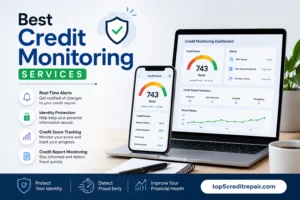
Identity theft and credit fraud don’t announce themselves. Most people find out something’s wrong only after a lender pulls their file and flags a stranger’s credit card, a new auto loan, or a hard inquiry they never authorized. By then, the damage is already sitting on the credit report.
A credit monitoring service closes that gap. It watches your credit file at one, two, or all three major bureaus — Equifax, Experian, and TransUnion — and sends an alert the moment something changes: a new account, a hard inquiry, a collections entry, or a shift in your score. Some services stop there. Others bundle in dark web scanning, identity theft insurance, and recovery support if your information is ever compromised.
Not every service covers the same ground, though, and the differences matter more than most people realize. A service that only monitors one bureau can miss fraud happening on the other two entirely. A “free” service might be ad-supported and light on real protection. A premium plan might cost $30+ a month for features you’ll never use.
We compared the leading credit monitoring services on bureau coverage, alert speed, identity protection features, ease of use, and price, to help you find the one that actually fits your situation.
Quick Comparison: Best Credit Monitoring Services
| Service | Best For | Bureaus Monitored | Starting Price |
|---|---|---|---|
| Experian | Best overall | 1–3 (plan-dependent) | Free plan available; paid plans add more coverage |
| Aura | Best all-in-one protection | 3 | ~$12–15/month |
| IdentityForce | Best for families | 3 (top plan) | ~$18–23/month |
| Credit Karma | Best free option | 2 (Equifax & TransUnion) | Free |
| PrivacyGuard | Best for detailed multi-bureau tracking | 3 | Entry tier available; full monitoring on upgraded plans |
Pricing changes frequently — always confirm current rates on the provider’s site before signing up.
1. Experian — Best Overall
Experian holds a unique advantage over every other service on this list: it’s one of the three credit bureaus itself, not just a company that pulls data from them. That means faster, more direct access to your Experian file, plus a free tier that’s genuinely useful rather than a stripped-down teaser.
The free plan gives you your Experian credit report and FICO Score, along with basic monitoring of your Experian file. Upgrading unlocks daily FICO Score updates, monitoring across all three bureaus, and identity theft alerts with credit lock features that let you freeze your file in a couple of taps if something looks off.
Experian’s mobile app is consistently rated among the easiest to use in the category, and because it’s tied directly to the bureau, dispute information and score changes tend to reflect faster than with third-party monitoring tools.
Pros:
- Free tier is one of the strongest in the industry, not a stripped-down trial
- Direct bureau access means faster data and dispute reflection
- Simple, well-reviewed mobile app with one-tap credit lock
- Paid plans add three-bureau monitoring and daily score refreshes
Cons:
- Free plan only covers the Experian file — TransUnion and Equifax activity won’t show up unless you upgrade
- Some users report frequent upsell prompts within the app
- Identity theft insurance is only included on higher-tier plans
Best for: Anyone who wants a genuinely useful free option with a clear, affordable upgrade path to full three-bureau coverage.
2. Aura — Best All-in-One Protection
Aura built its reputation by treating credit monitoring as one piece of a larger identity protection puzzle, not the whole picture. Every plan — even the entry-level individual tier — includes three-bureau credit monitoring, which is unusual; most competitors reserve that for their top plan.
Beyond credit, Aura monitors bank accounts, investment accounts, and financial transactions for suspicious activity, and scans the dark web for your personal information. It also bundles in a VPN, a password manager, and antivirus software, which makes it less of a “credit tool” and more of a full digital safety suite. Alert speed is consistently rated among the fastest in independent testing, often flagging changes within minutes rather than hours.
Family plans are competitively priced relative to the number of features included, and Aura backs its service with identity theft insurance up to $1 million per adult member.
Pros:
- Three-bureau monitoring included even on the base plan
- Fast alert delivery — frequently faster than competitors in side-by-side testing
- Bundled VPN, password manager, and antivirus add real value beyond credit monitoring
- Strong identity theft insurance coverage
Cons:
- More expensive than free alternatives like Credit Karma or Experian’s free tier
- The number of bundled tools can feel like more than casual users need
- Family plan pricing scales up quickly with more members
Best for: People who want comprehensive protection — credit, identity, and digital security — in a single subscription rather than juggling separate tools.
3. IdentityForce — Best for Families
IdentityForce’s UltraSecure+Credit plan is built around three-bureau monitoring, real-time alerts, and identity theft insurance coverage that can run up to $1 million, positioning it as a strong mid-tier option between budget-friendly single-bureau tools and premium all-in-one suites like Aura.
Where IdentityForce stands out is family and child protection. Its family plans include monitoring for children’s Social Security numbers, which matters because child identity theft can go undetected for years — kids don’t have credit files to check, so fraud on a minor’s SSN often isn’t discovered until they apply for their first credit card or student loan.
Independent testing has found IdentityForce’s alert speed to be slower than Aura’s, sometimes taking closer to a full day to flag a new inquiry, so it’s better suited to households prioritizing broad coverage and family features over speed.
Pros:
- Solid three-bureau monitoring on its top-tier plan
- Strong option for families, with dedicated child identity monitoring
- Meaningful identity theft insurance coverage
- Established company with a long track record in the space
Cons:
- Alert speed lags behind faster competitors like Aura
- Full three-bureau monitoring is locked behind the higher-priced plan
- Interface feels dated compared to newer, app-first competitors
Best for: Families who want to protect both their own credit and their children’s identities under one plan.
4. Credit Karma — Best Free Option
Credit Karma remains the most recognizable name in free credit monitoring, and for good reason: there’s no credit card required, no trial period that quietly converts to a paid plan, and no hidden fees. You get VantageScore 3.0 from Equifax and TransUnion, refreshed weekly, along with monitoring alerts for both bureaus and access to your full credit reports.
The catch — and it’s a significant one — is that Credit Karma never monitors Experian. If a lender pulls only your Experian file, or if fraud happens exclusively on that bureau, Credit Karma won’t catch it. The service is also ad-supported, recommending credit cards and loan products that generate affiliate revenue for the company, so recommendations inside the app shouldn’t be treated as neutral advice.
For everyday score tracking and catching most fraud early, though, Credit Karma is hard to beat for the price of free.
Pros:
- Completely free, with no credit card required
- Weekly score updates from two bureaus
- Clean, well-designed dashboard and mobile app
- Useful educational content explaining what’s affecting your score
Cons:
- Experian is never monitored, a meaningful blind spot
- Ad-supported model means constant product recommendations
- Uses VantageScore, not the FICO Score most lenders actually use
Best for: Budget-conscious users who want reliable baseline monitoring without paying anything, and who understand the Experian gap.
5. PrivacyGuard — Best for Multi-Bureau Detail
PrivacyGuard doesn’t have the brand recognition of Experian or Aura, but it earns its spot on this list through sheer depth of reporting. While many competitors only offer full three-bureau reports once a year, PrivacyGuard provides monthly access — a meaningful upgrade for anyone who wants to track their credit closely rather than check in occasionally.
The service includes a detailed three-bureau score tracker so you can watch trends over time rather than just seeing a single snapshot, plus a credit score simulator that models how specific financial decisions — paying down a balance, opening a new account — might affect your score before you make the move.
The main drawback is plan structure: PrivacyGuard’s entry-level tier doesn’t include full bureau monitoring, so budget-focused users may end up needing to upgrade to get the multi-bureau coverage that’s the service’s main selling point in the first place.
Pros:
- Monthly three-bureau credit reports, more frequent than most competitors
- Score trend tracking across all three bureaus
- Built-in credit score simulator for planning ahead
- Solid value for detail-focused users on upgraded plans
Cons:
- Entry-level plan lacks full bureau monitoring, which undercuts the core appeal
- Less brand recognition and fewer independent reviews than larger competitors
- Interface isn’t as polished as newer identity-protection apps
Best for: People who want to actively track credit trends over time and model financial decisions before making them, not just receive fraud alerts.
How to Choose the Right Credit Monitoring Service
There’s no single “best” service for everyone — the right pick depends on three things:
How many bureaus you actually need monitored. If a lender you care about (a mortgage broker, an auto lender, a specific credit card issuer) tends to pull one bureau over another, make sure that bureau is covered. Two-bureau free tools like Credit Karma work for general awareness, but they leave a real gap if fraud happens on the bureau they don’t track.
Whether you need identity protection beyond credit. If you’ve been through a data breach, work in a role with public contact information, or simply want broader protection, an all-in-one service like Aura or IdentityForce covers more ground than a credit-only tool.
Your budget and how often you’ll actually check it. A $30/month premium plan only pays off if you’re using the features. If you mainly want peace of mind and occasional alerts, a free or low-cost tier is often the more realistic long-term fit — you’re more likely to stick with a service you don’t resent paying for.
Whichever service you choose, remember that credit monitoring alerts you to problems; it doesn’t fix them. If you spot fraudulent accounts, unauthorized inquiries, or errors on your report, you’ll still need to file disputes directly with the credit bureaus or work with a reputable credit repair company to get them removed.
What Credit Monitoring Actually Tracks
It helps to know exactly what’s happening behind the scenes before you pick a service. Most credit monitoring tools watch for the same core set of changes on your credit file:
- New account openings — credit cards, auto loans, personal loans, or mortgages opened in your name
- Hard inquiries — applications for credit that can signal someone is trying to open new accounts using your information
- Changes in credit utilization — sudden spikes in balances relative to your credit limits
- Missed or late payment reporting — new derogatory marks added to your file
- Public records — bankruptcies, liens, or judgments tied to your name
- Personal information changes — a new address or alias appearing on your file, which is often an early sign of fraud
Higher-tier services add dark web scanning, which searches breach databases and underground marketplaces for your Social Security number, email addresses, and account credentials, giving you a heads-up before that stolen data gets used to open new accounts in your name.
Frequently Asked Questions
Is credit monitoring worth paying for? It depends on your risk level and what you need. Free services like Credit Karma or Experian’s basic plan cover the essentials — score tracking and basic alerts — at no cost. Paid services make more sense if you want three-bureau coverage, faster alerts, identity theft insurance, or extras like dark web scanning and family protection. If you’ve previously been part of a data breach or have a complex financial profile, paid monitoring is usually worth the cost.
What’s the difference between credit monitoring and identity theft protection? Credit monitoring specifically tracks your credit reports and alerts you to changes like new accounts, inquiries, or score shifts. Identity theft protection is broader — it typically includes credit monitoring plus dark web scanning, SSN monitoring, bank and investment account alerts, and often identity theft insurance and recovery assistance if your information is misused. Services like Aura and IdentityForce combine both.
Does checking my credit monitoring alerts hurt my credit score? No. Reviewing your own credit report or score through a monitoring service is a soft inquiry, which has no impact on your credit score. Only hard inquiries — like when you apply for a new loan or credit card — can cause a small, temporary dip.
Can credit monitoring stop identity theft before it happens? Not entirely. Monitoring services detect suspicious activity after it occurs, not before. What they offer is early detection, which matters because the faster you catch fraud, the easier it typically is to dispute and resolve before it does lasting damage to your score or finances.
Why do some services show a different score than others? Most free services display VantageScore, while paid services like myFICO show the FICO Score that the majority of lenders actually use when making credit decisions. The two models weigh factors slightly differently, so it’s normal to see a gap of 20–40 points between them. Neither score is “wrong” — they’re just calculated differently.
Is it better to monitor one bureau or all three? Three-bureau monitoring is almost always worth prioritizing if you can get it within your budget. Lenders don’t all pull the same bureau, and fraud can occur on a bureau you’re not watching without your knowledge. If cost is a concern, three-bureau paid plans are often only a few dollars more per month than single-bureau options.
Can I use more than one credit monitoring service at the same time? Yes, and some people do — for example, pairing a free service like Credit Karma with a paid, three-bureau option for more complete coverage. There’s no penalty for using multiple services, since checking your own credit never affects your score.
How quickly will I be alerted if something changes on my credit report? This varies significantly by provider. Some services deliver alerts within minutes of a change, while others can take up to a day. If alert speed matters to you — for example, if you’ve previously experienced fraud — it’s worth prioritizing a service with a strong track record for fast notifications over one that’s cheaper but slower to respond.
Final Thoughts
The best credit monitoring service is the one you’ll actually use consistently. A premium, feature-packed plan does nothing for you if the alerts get ignored or the app collects dust after the first week. Start by deciding how many bureaus you need covered and whether you want credit-only monitoring or broader identity protection, then match that to a budget you’re comfortable maintaining long-term. Catching a problem two days after it starts, instead of two months later, is often the difference between a quick fix and a drawn-out credit repair process.

About Stephen Joseph:
Stephen is a financial journalist with over a decade of experience covering personal finance, investing, and small business. His work has been widely featured across major outlets including MSN Money, Business Insider, Fox Business, and CBS News MoneyWatch. He currently serves as a financial planning expert and journalist.
In addition to his editorial work, Stephen partners with leading brands in the financial services industry — including Citibank, Discover Bank, and AIG Insurance — helping shape content strategy that connects with real consumers. Before transitioning into financial journalism, He built his professional foundation in sales within the communications industry.
Stephen holds a bachelor’s degree in Political Science from the University of South Carolina and a master’s degree from Charleston Southern University.