Credit Repair Advance Fee Ban: 7 Essential Rules You Must Know
Picture this: a credit repair company promises to wipe three collections accounts off your report, asks for $99 to “get started,” and tells you the real work begins once payment clears. If that sounds familiar, you’ve already run into exactly what federal law says a legitimate credit repair company is not allowed to do.
The credit repair advance fee ban is one of the oldest and most misunderstood consumer protection rules in the credit repair industry. It sounds simple — don’t charge before you deliver — but the way companies dance around it, and the way consumers get fooled by that dance, is where most credit repair complaints and lawsuits actually start.
What the Advance Fee Ban Actually Says
The ban comes from the Credit Repair Organizations Act (CROA), a federal law Congress passed in 1996 specifically because the credit repair industry at the time was full of companies that took people’s money and disappeared, or did nothing at all. The advance fee provision, codified at 15 U.S.C. § 1679b(b), is blunt: a credit repair organization cannot charge or receive money for its services until those services have been fully performed.
Not partially performed. Not “in progress.” Fully performed. That distinction is the entire point of the law, and it’s also the loophole companies try hardest to squeeze through.
If you take one thing away from this article, make it this: any credit repair company asking for an enrollment fee, setup fee, “processing” fee, or first month’s payment before it has actually completed the work it promised is violating federal law, full stop.
Why This Rule Exists in the First Place
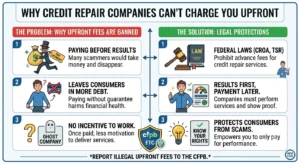
Congress didn’t write this rule in a vacuum. The legislative record behind CROA documented a pattern that was strikingly consistent: companies would collect fees upfront, file a handful of generic disputes (or none at all), and either vanish or keep billing monthly for work that produced nothing. Because the customer had already paid, the company had little financial incentive to actually finish the job — the money was already in hand regardless of outcome.
The advance fee ban directly attacks that incentive problem. By tying payment to completed performance, the law forces a credit repair company’s financial interest to line up with the customer’s actual outcome. If the company doesn’t do the work, it doesn’t get paid. That’s the whole design.
It’s also worth noting how unusual this structure is compared to most service industries. A lawyer can bill a retainer. A contractor can ask for a deposit. A gym can charge a membership fee before you’ve attended a single class. Credit repair companies are specifically carved out from that normal business practice because Congress concluded, based on documented harm, that the industry couldn’t be trusted to self-regulate around upfront payment. That history is worth keeping in mind any time a sales rep tries to explain why “our situation is different.”
The Loopholes Companies Try to Use
Because the advance fee ban is so restrictive, some companies have gotten creative — and not in a way that benefits you. Here are the tactics worth watching for.
“Per-item” or milestone billing. Some companies bill you a fee every time a dispute is “submitted,” arguing that submitting a dispute counts as a completed service. Regulators have pushed back on this repeatedly. The FTC has previously stated that charging for intermediate steps, rather than final results, is itself an evasion of the advance fee ban. Submitting a letter is not the same as fixing your credit.
Calling it something other than a “fee.” Renaming an upfront charge as a “consultation,” “audit,” or “enrollment” charge doesn’t change what it legally is. If money changes hands before the promised credit repair service is complete, CROA treats it the same regardless of the label on the invoice.
Bundling with a separate, allowable product. A handful of companies pair credit repair with a legitimately sellable product — credit monitoring, for instance — and charge upfront only for the monitoring piece while quietly delivering the credit repair work as a “bonus.” This can be a legal gray area depending on how clearly it’s disclosed, but it’s still worth scrutinizing closely, because the substance of what you’re paying for matters more than what it’s called on paper.
Telemarketing sales that ask for a card number “just to hold your spot.” If a company is selling credit repair services over the phone, an even stricter rule applies (more on that below), and asking for payment information during that call is a serious red flag.
The Telemarketing Sales Rule Makes It Even Stricter
Most people assume CROA’s advance fee ban is the strictest version of this rule. It isn’t. If a credit repair company sells its services through telemarketing, the FTC’s Telemarketing Sales Rule (TSR) applies a tougher standard under its Credit Repair Rule. Under 16 C.F.R. § 310.4(a)(2), a telemarketing credit repair company cannot request or receive payment until six months after the promised results have been achieved, and it must be able to demonstrate that those results have actually lasted for that six-month period.
In practice, this means a company that cold-calls or robocalls you about credit repair is held to an even higher bar than one you found through a website or referral. If a telemarketer asks for payment on the first call, or even within the same month results were supposedly delivered, that’s a clear violation.
What “Fully Performed” Actually Means
This phrase does a lot of work in the statute, and it’s worth being precise about it. “Fully performed” generally means the specific service promised in your contract has been completed — not attempted, not started, completed. If your contract says the company will dispute three specific negative items and follow through to a final result (deletion, verification, or correction), payment isn’t legally due until that process has run its course for those items.
This is also why a detailed, specific written contract matters so much. CROA separately requires credit repair companies to give you a written contract describing the services, the timeline, and the total cost, before any money changes hands. A vague contract that doesn’t clearly define what counts as “the service” makes it much easier for a company to claim it has fulfilled its obligation prematurely.
Who the Advance Fee Ban Applies To — and Who It Doesn’t
CROA’s advance fee ban applies broadly to any person or business that takes money to improve, repair, or alter a consumer’s credit record, credit history, or credit rating. It doesn’t matter whether the company calls itself “credit repair,” “credit consulting,” “credit coaching,” or “file optimization” — if the underlying service is credit repair sold for a fee, the law applies regardless of the label.
There are a few carve-outs. Nonprofit credit counseling organizations are generally exempt, as are licensed attorneys providing legal services and, in most interpretations, banks and other federally regulated financial institutions acting within their normal business. If a company is leaning heavily on one of these exemptions to justify charging upfront, it’s worth confirming that exemption actually applies rather than taking the claim at face value.
What Happens If a Company Violates the Ban
A violation of the advance fee ban isn’t just a contract dispute — it’s treated as an unfair or deceptive act under the FTC Act, and CROA gives consumers a direct path to do something about it. Under 15 U.S.C. § 1679g, you can sue a company that violated the advance fee ban (or other CROA provisions) and potentially recover actual damages, statutory damages of up to $1,000 for an individual claim, punitive damages, and attorney’s fees.
In practice, most individual consumers don’t file lawsuits over a $99 enrollment fee, since the cost of litigation often outweighs what’s recoverable on its own. That’s part of why enforcement by the FTC, the CFPB, and state attorneys general matters so much — those agencies can pursue systemic violations across an entire company’s customer base rather than one small claim at a time. It’s also why documentation matters: if you ever do need to pursue a claim, dated contracts, payment receipts, and copies of every promise made in writing are what turn a frustrating experience into an enforceable one.
How to Protect Yourself Before You Sign Anything
Read the payment terms line by line. Before you sign a contract, find the exact sentence describing when payment is due. If it says anything other than “after services are completed,” ask why.
Be suspicious of “setup” or “enrollment” fees. These are almost always advance fees wearing a different name. A company that’s confident in its work doesn’t need money before doing it.
Get the contract in writing before paying anything. CROA requires a written contract describing the specific services, the timeframe, and the total cost. If a company pressures you to pay before providing that document, walk away.
Ask what “fully performed” means in your specific contract. A reputable company will be able to explain exactly what triggers payment. If the answer is vague, that vagueness is doing work to protect the company, not you.
Check for the three-day cancellation right. CROA also requires that you be given the right to cancel within three business days of signing without penalty. If that right is missing from your contract, that’s a second red flag stacked on top of any advance fee issue.
Compare against companies with a long, verifiable track record. With federal enforcement resources stretched thinner in recent years, doing your own research before paying anyone matters more than it used to. A company’s history of reviews, complaint patterns, and time in business tell you more than a polished sales pitch ever will.
What a Real Advance Fee Violation Looks Like
To make this concrete, here’s a pattern that shows up again and again in FTC and state enforcement actions. A company advertises “credit repair starting at $49.” A consumer signs up, pays the $49 the same day, and is told disputes will be filed “within the first billing cycle.” A month passes. The consumer is billed again — same amount, same description. No deletions have happened. No updated credit report has been shared. When the consumer asks for a status update, they’re told the process “takes time” and to keep paying while it works.
Every part of that pattern is a credit repair advance fee ban violation. The initial $49 charge came before any service was performed. The second month’s charge came before the first month’s promised work had produced a completed result. And the vague “it takes time” response is a tell that the company has no specific, contractually defined trigger for when payment is actually owed — which is exactly the ambiguity the law is designed to prevent.
Contrast that with how a compliant company operates: it identifies specific negative items in your contract, disputes them, waits for the credit bureau’s response, and only then invoices you for that completed round of work. If nothing was resolved, nothing is billed. That structural difference — pay for outcomes, not for effort or time — is the entire test for whether a company is honoring the advance fee ban or quietly working around it.
The Bottom Line
The credit repair advance fee ban exists for one reason: to make sure a credit repair company only gets paid when it actually does the work it promised. That single rule, tucked into a decades-old federal statute, is still one of the most effective consumer protections in an industry that’s historically attracted more than its share of bad actors. Understanding exactly what counts as an advance fee, and exactly what “fully performed” means, is the single best way to avoid handing money to a company that has no real incentive to earn it.
Frequently Asked Questions
Can a credit repair company charge a “setup fee” before doing any work?
No. A setup fee, enrollment fee, or processing fee charged before services are completed violates the CROA advance fee ban, regardless of what the fee is called.
Is it legal for a credit repair company to charge monthly if I haven’t seen results yet?
Generally no. Charging on a recurring schedule before the promised service has been fully completed is the exact structure the advance fee ban was written to prevent, since it separates payment from actual results.
What’s the difference between CROA’s advance fee ban and the Telemarketing Sales Rule?
CROA requires payment only after services are fully performed. The Telemarketing Sales Rule’s Credit Repair Rule is stricter for companies selling by phone, requiring a wait of six months after results are achieved, and proof those results have lasted, before payment can be collected.
Are there any companies that can legally charge upfront for credit-related services?
Nonprofit credit counseling agencies and licensed attorneys are generally exempt from CROA’s advance fee ban. If a for-profit credit repair company claims an exemption, it’s worth verifying that claim rather than assuming it’s accurate.
What should I do if I already paid an advance fee and got nothing in return?
Document everything — the contract, payment receipts, and any promises made in writing or recorded calls. You can file a complaint with the FTC, your state attorney general’s consumer protection office, and, depending on the amount involved, consult a consumer protection attorney about a potential CROA claim.
Does the advance fee ban apply to DIY credit repair software or apps?
It depends on what’s actually being sold. If a product is simply a tool you use yourself, without the company performing the disputes or credit repair work on your behalf, CROA’s advance fee provisions typically don’t apply the same way they do to a full-service credit repair company. Read the terms carefully to understand what you’re actually paying for.

About Stephen Joseph:
Stephen is a financial journalist with over a decade of experience covering personal finance, investing, and small business. His work has been widely featured across major outlets including MSN Money, Business Insider, Fox Business, and CBS News MoneyWatch. He currently serves as a financial planning expert and journalist.
In addition to his editorial work, Stephen partners with leading brands in the financial services industry — including Citibank, Discover Bank, and AIG Insurance — helping shape content strategy that connects with real consumers. Before transitioning into financial journalism, He built his professional foundation in sales within the communications industry.
Stephen holds a bachelor’s degree in Political Science from the University of South Carolina and a master’s degree from Charleston Southern University.