Debt Consolidation Loans Guide: How to Combine Your Debt and Regain Control in 2026
Juggling five different credit card bills, two personal loans, and a store card you barely remember opening is exhausting. Different due dates, different interest rates, different minimum payments — it’s a system practically designed to make you miss something and get hit with a late fee or a rate hike. If this sounds familiar, you’ve probably already searched for a way out, and one term keeps showing up: debt consolidation loans.
This guide breaks down exactly what debt consolidation loans are, how they work, who they’re a good fit for, and how to avoid the mistakes that trip up a lot of first-time borrowers. No jargon, no sales pitch — just a clear-eyed look at whether this strategy makes sense for your situation.
What Is a Debt Consolidation Loan?
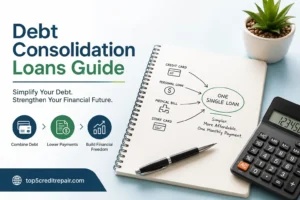
A debt consolidation loan is a new loan you take out specifically to pay off multiple existing debts — think credit cards, medical bills, payday loans, or other personal loans — and roll them into a single monthly payment. Instead of tracking four or five due dates and interest rates, you’re left with one loan, one payment, and (ideally) one interest rate that’s lower than what you were paying before.
It’s important to understand what this loan does and doesn’t do. It doesn’t erase your debt or reduce the amount you owe. What it does is restructure how you pay it back — often with a lower interest rate, a fixed repayment term, and a predictable monthly bill.
Most debt consolidation loans are unsecured personal loans, meaning you don’t need to put up your house or car as collateral. Some lenders also offer secured consolidation loans, which use an asset as collateral in exchange for a lower rate — but that comes with the risk of losing that asset if you default.
How Debt Consolidation Loans Actually Work
The process is more straightforward than most people expect:
- You apply for a new loan with a bank, credit union, or online lender, requesting an amount equal to (or slightly more than) your total outstanding debt.
- The lender reviews your credit profile, income, and debt-to-income ratio to determine your eligibility, loan amount, and interest rate.
- Once approved, the funds are disbursed — sometimes directly to your creditors (common with balance-transfer-style consolidation), and sometimes to you, after which you pay off each creditor yourself.
- You close out your old accounts as they’re paid off, though it’s often wise to keep credit card accounts open (just unused) to preserve your credit utilization ratio.
- You start making a single monthly payment toward the new consolidation loan until it’s paid off, typically over a term of two to seven years.
The entire point is simplification paired with cost savings — assuming you qualify for a rate lower than your blended average rate across your existing debts.
Types of Debt Consolidation Options
Not all consolidation strategies look the same. Here’s how the main options compare.
| Option | Best For | Typical Rate Range | Collateral Needed |
|---|---|---|---|
| Unsecured personal loan | Good-to-excellent credit borrowers | 7% – 25% | No |
| Secured consolidation loan | Borrowers with assets, lower credit scores | 6% – 18% | Yes (home, car, savings) |
| Balance transfer credit card | Smaller debt amounts, short-term payoff | 0% intro APR, then 18%+ | No |
| Home equity loan or HELOC | Homeowners with significant equity | 6% – 12% | Yes (home) |
| 401(k) loan | Those with retirement savings, as a last resort | Prime rate + 1-2% | Yes (retirement funds) |
| Debt management plan (via credit counseling) | Those who don’t qualify for loans | Negotiated with creditors | No |
Each path has trade-offs. A 0% balance transfer card sounds appealing, but the promotional rate usually expires in 12–21 months, and if you haven’t paid off the balance by then, the remaining amount can be hit with a steep retroactive or standard APR. Home equity products often carry the lowest rates but put your house on the line.
Debt Consolidation Loan Pros and Cons
Pros:
- Simplifies your finances — one payment instead of several, which reduces the chance of missed payments.
- Potentially lowers your interest rate, especially if you’re consolidating high-interest credit card debt into a lower-rate personal loan.
- Fixed repayment timeline gives you a clear payoff date, unlike revolving credit card debt that can drag on indefinitely.
- Can improve your credit score over time by lowering your credit utilization ratio and demonstrating consistent on-time payments.
- Predictable budgeting since your monthly payment amount doesn’t fluctuate.
Cons:
- You need decent credit to get a good rate. Borrowers with poor credit may be offered rates similar to or even worse than their existing debt.
- Origination fees (often 1%–8% of the loan amount) can eat into your savings.
- It doesn’t fix spending habits. If the underlying issue is overspending, consolidation just resets the clock — many people end up racking up new credit card debt on top of the consolidation loan.
- Secured options put assets at risk if you’re unable to keep up with payments.
- A temporary credit score dip is common right after applying, due to the hard credit inquiry and new account.
Who Should Consider a Debt Consolidation Loan?
Debt consolidation tends to work best for people who:
- Have multiple high-interest debts (typically credit cards above 18–20% APR)
- Have a stable income and can comfortably manage a fixed monthly payment
- Have a credit score in the fair-to-good range (typically 640+) to qualify for a meaningful rate reduction
- Have already addressed the spending behavior that led to the debt in the first place
- Want a clear, defined payoff date rather than open-ended revolving debt
If your credit score is low (below 600) and you’re struggling just to make minimum payments, a consolidation loan might not offer meaningful savings — and in some cases, a credit counseling agency or debt management plan may be a more realistic first step.
Debt Consolidation Loan vs. Credit Repair vs. Debt Settlement
These three terms get confused constantly, so it’s worth clarifying the difference:
- Debt consolidation restructures how you repay debt you still fully owe. Your total balance doesn’t shrink; your payment structure does.
- Debt settlement involves negotiating with creditors to pay less than the full amount owed, usually through a settlement company. This can severely damage your credit and often comes with tax implications on the forgiven amount.
- Credit repair focuses on disputing inaccurate, outdated, or unverifiable items on your credit report — it doesn’t address the debt itself, but can improve your credit score if there are legitimate errors dragging it down.
Some people use these strategies together — for example, working with a credit repair company to clean up their report first, which can help them qualify for a better consolidation loan rate down the line.
How to Qualify for the Best Debt Consolidation Loan Rates
Lenders typically evaluate four main factors:
- Credit score — higher scores unlock lower rates. Most lenders reserve their best rates for scores of 720+.
- Debt-to-income ratio (DTI) — lenders want to see that your monthly debt obligations, including the new loan, stay well under 40% of your gross income.
- Employment and income stability — steady income history reassures lenders you can maintain payments.
- Existing relationship with the lender — banks and credit unions sometimes offer preferential rates to existing customers.
A few practical steps before applying:
- Check your credit reports for errors at Identity Iq and dispute anything inaccurate.
- Pay down small balances first if possible, to improve your DTI ratio before applying.
- Get prequalified with multiple lenders. Most offer soft-pull prequalification that won’t affect your credit score, letting you compare offers side by side.
- Compare APR, not just interest rate — APR includes fees and gives a truer picture of total cost.
Common Mistakes to Avoid
- Not calculating total cost. A lower monthly payment stretched over a longer term can actually cost more in total interest. Always compare total repayment amounts, not just the monthly figure.
- Closing all credit cards immediately. This can shorten your average credit age and spike your utilization ratio if not managed carefully.
- Using freed-up credit cards to rack up new debt. This is the single most common reason consolidation fails — the old cards get paid off, then used again.
- Ignoring fees. Origination fees, prepayment penalties, and balance transfer fees can offset a chunk of your interest savings.
- Choosing the first offer without comparing multiple lenders. Rates can vary significantly between banks, credit unions, and online lenders for the same borrower profile.
Where to Get a Debt Consolidation Loan
You generally have three categories of lenders to choose from:
- Credit unions often offer the most competitive rates, especially for members with existing accounts, though membership requirements apply.
- Online lenders provide fast approvals and pre qualification tools, making it easy to compare rates without a hard credit pull, though rates can run higher for lower credit tiers.
- Traditional banks may offer relationship-based discounts but often have stricter credit requirements.
Whichever route you choose, get at least three quotes before committing. A half-percent difference in APR might not sound like much, but on a $15,000 loan over five years, it can add up to hundreds of dollars in extra interest.
Frequently Asked Questions
Does a debt consolidation loan hurt your credit score?
There’s usually a small, temporary dip when you apply, caused by the hard credit inquiry and the new account lowering your average account age. Over time, though, consistent on-time payments and a lower credit utilization ratio typically help your score recover and often improve beyond where it started.
How much can I save with a debt consolidation loan?
Savings depend entirely on the interest rate difference between your old debts and the new loan, plus any fees involved. Someone consolidating credit card debt at 24% APR into a personal loan at 11% APR could save a substantial amount in interest over the loan term — but it’s worth running the numbers with an online debt consolidation calculator before committing.
Can I get a debt consolidation loan with bad credit?
Yes, though options are more limited and rates tend to be higher. Secured consolidation loans, credit union loans, or working with a co-signer can improve approval odds. Some borrowers with poor credit find that a nonprofit debt management plan offers better terms than a consolidation loan.
Is debt consolidation the same as debt settlement?
No. Debt consolidation pays off your full balance through a new loan, while debt settlement involves negotiating to pay less than what’s owed, which typically damages your credit more significantly and can have tax consequences.
How long does it take to pay off a debt consolidation loan?
Most consolidation loans have terms between two and seven years. A shorter term means higher monthly payments but less total interest paid, while a longer term lowers the monthly payment but increases the total cost over time.
Will closing my credit cards after consolidating hurt my credit?
It can, particularly if it significantly shortens your credit history or spikes your utilization on remaining cards. Many financial advisors recommend keeping older accounts open with a zero balance rather than closing them outright.
What credit score do I need for a debt consolidation loan?
While some lenders work with scores as low as 580–600, the most competitive rates are typically reserved for borrowers with scores of 690 and above. Improving your score before applying, even by 20–30 points, can meaningfully lower your offered rate.
Are there alternatives if I don’t qualify for a good rate?
Yes. Nonprofit credit counseling agencies offer debt management plans that negotiate lower interest rates directly with creditors without requiring a new loan. Credit repair services can also help address reporting errors that may be suppressing your score before you apply for consolidation.
Final Thoughts
A debt consolidation loan can be a genuinely useful tool — but it works best as part of a broader plan, not a standalone fix. If you qualify for a meaningfully lower rate, can commit to a fixed repayment schedule, and are ready to change the habits that led to the debt in the first place, consolidation can simplify your finances and save you real money. If your credit needs work first, or the underlying spending patterns haven’t changed, it’s worth exploring credit repair or nonprofit credit counseling before taking on a new loan. Either way, comparing multiple offers and reading the fine print on fees and terms is the difference between a consolidation loan that helps and one that just delays the problem.

About Stephen Joseph:
Stephen is a financial journalist with over a decade of experience covering personal finance, investing, and small business. His work has been widely featured across major outlets including MSN Money, Business Insider, Fox Business, and CBS News MoneyWatch. He currently serves as a financial planning expert and journalist.
In addition to his editorial work, Stephen partners with leading brands in the financial services industry — including Citibank, Discover Bank, and AIG Insurance — helping shape content strategy that connects with real consumers. Before transitioning into financial journalism, He built his professional foundation in sales within the communications industry.
Stephen holds a bachelor’s degree in Political Science from the University of South Carolina and a master’s degree from Charleston Southern University.