Debt Settlement vs Credit Repair vs Counseling: Which One Is Right for You?
There’s a particular kind of stress that comes with financial trouble — the kind that wakes you up at 3 a.m., makes you dread the mailbox, and puts a quiet strain on every relationship in your life. If you’re dealing with mounting debt, a damaged credit score, or both, you’re not alone. Millions of Americans find themselves in similar situations every year, searching for a way out.
The good news is that there are real solutions available. The confusing part? Knowing which one actually fits your situation.
You’ve probably heard the terms thrown around: debt settlement, credit repair, and credit counseling. They sound similar. They’re often lumped together in financial advice articles. But they are fundamentally different tools, designed for different problems, with very different outcomes.
This guide is here to cut through the noise. By the time you finish reading, you’ll understand exactly what each option involves, what it costs, how it affects your credit, and — most importantly — which one is the right fit for where you are right now.
Understanding the Basics: What Problem Are You Actually Trying to Solve?
Before diving into the differences, it helps to get clear on the problem you’re facing. Ask yourself:
- Are you drowning in debt you genuinely cannot pay, and you need relief fast?
- Is your credit score damaged due to past mistakes, errors, or negative items on your report?
- Do you have manageable debt but feel lost and need a structured plan to pay it off?
Your answer will point you toward the right solution. Let’s break down each option in detail.
What Is Debt Settlement?
The Core Idea
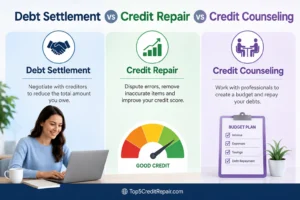
Debt settlement is exactly what it sounds like: you negotiate with your creditors to pay less than the full amount you owe. Typically, a settlement involves paying a lump sum — often 40% to 60% of the original balance — in exchange for the creditor forgiving the remainder.
This option is usually for people who are significantly behind on payments, dealing with collections, or facing potential lawsuits from creditors. It’s a last resort for people in genuine financial hardship — not a shortcut for people who simply don’t want to pay their bills.
How the Process Works
Debt settlement can be done two ways: on your own (DIY negotiation) or through a debt settlement company.
DIY Debt Settlement: You contact your creditors directly, explain your financial hardship, and propose a lump sum payment. Many creditors would rather receive something than spend years chasing a debt. If you have some savings and a lot of nerve, this can be surprisingly effective.
Through a Debt Settlement Company: These companies ask you to stop paying your creditors and instead deposit money into a dedicated savings account. Once enough funds accumulate, the company negotiates with your creditors on your behalf. This process typically takes two to four years.
The Real Costs of Debt Settlement
Debt settlement is not cheap, and the costs go beyond fees:
Company fees: Most debt settlement companies charge 15% to 25% of the enrolled debt or the settled amount. On a $30,000 debt, that could be $4,500 to $7,500 in fees alone.
Tax consequences: The IRS considers forgiven debt as taxable income. If your creditor forgives $10,000, you may owe taxes on that $10,000. This surprises many people and can create a new financial headache.
Credit score damage: Stopping payments — which most debt settlement programs require — will devastate your credit score. You’ll accumulate late payments, and eventually delinquencies and collection accounts, which stay on your report for seven years.
Lawsuits: While you’re not paying your creditors, some may sue you to collect. This is a real risk that settlement companies often downplay.
When Debt Settlement Makes Sense
Debt settlement is appropriate when:
- You are significantly behind on payments already
- You cannot realistically pay the full amount even with a strict budget
- You’re facing collections or legal action from creditors
- Bankruptcy feels like the only other alternative
- You have (or can save) a lump sum to offer as settlement
When It Doesn’t Make Sense
Debt settlement is the wrong tool if:
- Your credit is currently in decent shape and you want to protect it
- You can manage your debt with a structured payment plan
- You’re dealing with federal student loans, which have different options
- You only have a few thousand dollars in debt that’s manageable
What Is Credit Repair?
The Core Idea
Credit repair is the process of reviewing your credit reports, identifying errors, inaccuracies, or outdated negative items, and working to have them corrected or removed. The goal is to improve your credit score — not to eliminate or reduce your debt.
This is an important distinction. Credit repair doesn’t touch your debt. It addresses your credit report.
How Credit Repair Works
Under the Fair Credit Reporting Act (FCRA), you have the legal right to dispute inaccurate, incomplete, or unverifiable information on your credit reports. Credit repair — whether done by yourself or through a company — leverages this right.
DIY Credit Repair: You request free copies of your credit reports from all three bureaus (Equifax, Experian, and TransUnion) at Identity Iq. You then review each report line by line for errors, such as:
- Accounts that don’t belong to you (signs of identity theft)
- Incorrect account statuses (e.g., a paid account listed as unpaid)
- Duplicate accounts
- Negative items that are outdated (most negative items must be removed after seven years)
- Wrong personal information
You file disputes directly with the credit bureaus, and they are required by law to investigate and respond within 30 days.
Through a Credit Repair Company: These companies do the legwork for you — pulling reports, identifying errors, filing disputes, and following up. They can be helpful if the process feels overwhelming, but it’s important to know that they cannot do anything for you that you cannot legally do yourself.
What Credit Repair Can and Cannot Do
It CAN:
- Remove legitimate errors from your report
- Get outdated negative items removed if the bureau fails to verify them within 30 days
- Improve your score significantly if there are genuine errors dragging it down
- Correct identity theft damage
It CANNOT:
- Remove accurate, verifiable negative information (regardless of what some companies claim)
- Improve your score overnight — legitimate credit repair takes months
- Eliminate your debt
- Guarantee results
The Cost of Credit Repair
DIY credit repair is essentially free, aside from your time and postage for certified letters.
Credit repair companies typically charge:
- A setup fee: $15 to $200
- Monthly fees: $50 to $150 per month
- Some charge per deletion: $25 to $75 per item removed
The Credit Repair Organizations Act (CROA) requires companies to provide a written contract, give you three days to cancel without penalty, and prohibits them from charging upfront fees before completing services.
Warning: Beware of Credit Repair Scams
The credit repair industry is notorious for predatory companies that overpromise and underdeliver. Red flags include:
- Guaranteeing they can remove all negative items
- Asking for full payment upfront
- Telling you to dispute everything, even accurate information
- Suggesting you create a “new” credit identity using an Employer Identification Number (EIN) — this is illegal
- Refusing to explain your legal rights to you
When Credit Repair Makes Sense
Credit repair is the right option when:
- Your credit score is being held down by errors or inaccuracies
- You’ve been a victim of identity theft
- You have outdated negative items that should have aged off your report
- You’re planning a major financial move (mortgage, car loan) and need to improve your score
- Your debt is under control, but your credit report doesn’t reflect your current situation
When It Doesn’t Make Sense
Credit repair won’t help you if:
- The negative items on your report are accurate and recent
- Your main problem is too much debt, not inaccurate reporting
- You’re looking for a quick fix — even successful credit repair takes time
Our Recommendation top 5 Credit Repair Companies
- The Credit Pros – Best for Comprehensive Plans
- Credit Saint – Best for Customized Pricing
- Sky Blue Credit – Best Value
- The Credit People – Best for Low Setup Fees
- Credit Firm– Best for Legal Support
What Is Credit Counseling?
The Core Idea
Credit counseling is a financial guidance service, typically offered by nonprofit organizations, that helps you understand your financial situation, create a budget, and develop a plan to pay off your debt. Many credit counseling agencies also offer Debt Management Plans (DMPs), which are structured repayment programs negotiated with your creditors.
Credit counseling is the most “collaborative” of the three options. You’re not fighting creditors or disputing reports — you’re getting educated, organized, and supported.
How Credit Counseling Works
The Initial Session: A certified credit counselor reviews your income, expenses, and debts in a comprehensive session, usually 60 to 90 minutes. This session is typically free. The counselor helps you understand your complete financial picture and presents your options.
Debt Management Plans (DMPs): If your debt load is manageable but you need structure, a DMP may be recommended. Here’s how it works:
- The agency negotiates with your creditors to reduce your interest rates (often significantly — from 24% down to 6% to 9% is common)
- You make a single monthly payment to the agency
- The agency distributes payments to each of your creditors
- The plan typically runs three to five years
- At the end, your unsecured debts are paid in full
Note: DMPs are not suitable for secured debts (like mortgages or car loans) or student loans. They work best for credit card debt and unsecured personal loans.
The Cost of Credit Counseling
Credit counseling from a legitimate nonprofit agency is very affordable:
- Initial session: Free
- DMP setup fee: $0 to $75
- Monthly DMP fee: $25 to $50 per month
- Total cost over a 4-year plan: roughly $1,200 to $2,400 in fees
Compare that to debt settlement fees of $4,500 to $7,500 on the same balance, and the value of credit counseling becomes clear.
Look for agencies accredited by the National Foundation for Credit Counseling (NFCC) or the Financial Counseling Association of America (FCAA). These organizations set ethical standards for member agencies.
How Credit Counseling Affects Your Credit
This depends on whether you enroll in a DMP. When you start a DMP, your creditors may note it on your credit report as “enrolled in credit counseling.” This notation is generally less damaging than the effects of debt settlement or the defaults that often precede it.
Importantly, as you make consistent on-time payments through the DMP, your payment history — the single largest factor in your credit score — improves steadily. Most people come out of a DMP with a significantly better credit score than when they entered.
When Credit Counseling Makes Sense
Credit counseling is the right fit when:
- Your debt is manageable but you’re struggling to make progress
- You’re paying high interest rates and want relief
- You need professional guidance and accountability
- Your budget feels out of control
- You want to pay your debt in full (not settle for less)
- You want to protect or rebuild your credit score while addressing debt
When It Doesn’t Make Sense
Credit counseling may not be the best option if:
- Your debt is so overwhelming that even a reduced interest rate won’t make payments affordable
- You have significant secured debt (the DMP won’t address your mortgage or car loans)
- You need immediate relief and can’t commit to a multi-year plan
Side-by-Side Comparison: Debt Settlement vs Credit Repair vs Credit Counseling
| Feature | Debt Settlement | Credit Repair | Credit Counseling |
|---|---|---|---|
| Main Goal | Reduce what you owe | Fix credit report errors | Pay off debt with structure |
| Works Best For | Severe debt hardship | Inaccurate credit reports | Manageable debt with high interest |
| Impact on Credit Score | Severely negative | Potentially positive | Slightly negative, improves over time |
| Affects Your Debt? | Yes – reduces balance | No | Yes – paid in full |
| Typical Timeline | 2–4 years | 3–6 months | 3–5 years |
| Average Cost | 15–25% of debt | $50–$150/month | $25–$50/month |
| Tax Implications | Forgiven debt is taxable | None | None |
| Risk Level | High (lawsuits, score damage) | Low to moderate | Low |
| DIY Option Available? | Yes | Yes | Partially |
The Human Reality: What Nobody Tells You
Here’s what the brochures and comparison articles tend to leave out: all three of these paths are emotionally difficult, even when they’re working.
With debt settlement, there’s the anxiety of deliberately falling behind on bills, the creditor calls, and the uncertainty of whether your creditor will even settle. People often feel shame during this process, which is completely understandable — but it’s worth knowing that hardship is not a moral failure. Sometimes circumstances change in ways we never planned for.
With credit repair, the waiting is hard. You file disputes and then… you wait. And wait. The 30-day clock feels endless when you’re hoping to get approved for a home or car. Be patient. Dispute resolution takes time, and results aren’t always dramatic.
With credit counseling, the challenge is the long game. A Debt Management Plan runs for three to five years. That’s a real commitment. You may need to close some credit cards, live on a tight budget, and resist the urge to give up when progress feels slow. But for many people, the consistent monthly payments, lower interest rates, and accountability from a counselor make all the difference.
Whatever path you choose, getting started is the hardest part. The moment you take action — any action — the weight often feels a little lighter.
Can You Combine These Approaches?
Sometimes, yes. Here are a few scenarios where a combination makes sense:
Debt Settlement + Credit Repair: After settling debts, your report will show the settled accounts. Once the dust settles, you can work on disputing any errors and building positive new credit history to begin recovering your score.
Credit Counseling + Credit Repair: If you’re on a DMP and you notice errors on your credit report, there’s no reason you can’t dispute those simultaneously. Removing inaccuracies while making consistent payments on the DMP can accelerate score improvement.
Sequential Approach: If you’re in severe debt now and settlement is necessary, you might settle first, then focus on credit rebuilding and repair once you’re financially stable.
How to Protect Yourself: Choosing a Legitimate Provider
Regardless of which path you choose, the industry has its share of bad actors. Here’s how to protect yourself:
For Debt Settlement Companies:
- Look for members of the American Association for Debt Resolution (AADR)
- Avoid companies that guarantee results or specific settlement percentages
- Never pay upfront fees before any debt is settled (this is illegal under FTC rules)
- Read all contracts carefully
For Credit Repair Companies:
- Verify they comply with the Credit Repair Organizations Act (CROA)
- Check reviews on the Better Business Bureau (BBB)
- Avoid any company claiming they can create a “new” credit identity for you
- Remember: anything they can do, you can do yourself for free
For Credit Counseling Agencies:
- Choose NFCC or FCAA accredited agencies
- Verify nonprofit status
- Be wary of “nonprofit” agencies that charge excessive fees
- Use the Consumer Financial Protection Bureau (CFPB) resources to find vetted agencies
Quick Guide: Which Option Is Right for You?
Choose debt settlement if: You’re already seriously delinquent, collections are calling, you genuinely cannot afford to pay the full balance, and you have some savings to offer as a lump sum. You’re prepared for serious credit damage and potential tax consequences.
Choose credit repair if: Your primary issue is errors, inaccuracies, or outdated negative items on your credit report. Your debt is manageable, but your credit score doesn’t reflect your actual creditworthiness. You want to clean up the report ahead of a major financial move.
Choose credit counseling if: You have more debt than you can manage comfortably, but you’re still able to make some payment each month. You want to pay what you owe in full, reduce your interest rates, and have someone guide you through a structured plan. You want to protect and rebuild your credit along the way.
Final Thoughts: There’s No Shame in Getting Help
Financial difficulty is one of the most stressful things a person can go through, and yet it’s one of the most common human experiences. Tens of millions of people have walked this road before you and found their way to the other side.
The first step is the hardest one: admitting that you need a different approach and asking for help. Whether that means calling a nonprofit credit counselor, writing a dispute letter to the credit bureaus, or negotiating with a creditor, taking action is always better than staying stuck.
Debt settlement, credit repair, and credit counseling are not magic wands. They are tools — each designed for a specific problem, each with its own trade-offs. When you match the right tool to the right problem, you give yourself the best possible chance of getting your finances back on track.
You don’t have to figure this out alone. Start with one step today.
Frequently Asked Questions
Can debt settlement companies guarantee that creditors will settle? No legitimate company can guarantee this. Creditors are not obligated to negotiate, though many will if you’re significantly delinquent.
Does credit repair remove legitimate negative items? Legitimate credit repair only removes inaccurate, outdated, or unverifiable information. Any company claiming to remove accurate negative items is misleading you.
Will a Debt Management Plan close my credit cards? Often, yes. Most creditors require that you close enrolled accounts as part of a DMP. This can temporarily affect your score but is typically worth the trade-off.
How long do negative items stay on my credit report? Most negative items (late payments, collections, charge-offs) remain for seven years. Bankruptcies can stay for up to ten years.
Can I do any of these on my own without paying a company? Yes. You can negotiate directly with creditors for settlement, file your own credit disputes for free, and access credit counseling through nonprofit agencies that often provide free initial sessions.

About Stephen Joseph:
Stephen is a financial journalist with over a decade of experience covering personal finance, investing, and small business. His work has been widely featured across major outlets including MSN Money, Business Insider, Fox Business, and CBS News MoneyWatch. He currently serves as a financial planning expert and journalist.
In addition to his editorial work, Stephen partners with leading brands in the financial services industry — including Citibank, Discover Bank, and AIG Insurance — helping shape content strategy that connects with real consumers. Before transitioning into financial journalism, He built his professional foundation in sales within the communications industry.
Stephen holds a bachelor’s degree in Political Science from the University of South Carolina and a master’s degree from Charleston Southern University.